

Quick answer
What you need to know
Choosing the wrong data entry provider costs more than doing the work in-house. Here is a practical checklist of what to evaluate before you sign a contract.
What Should You Evaluate Before Outsourcing Data Entry?
Accuracy Rate and Quality Control Process
Data Security and Confidentiality Practices
Premium reader tools
Turn insight into action
The brief, before you dive in
A practical snapshot of what this guide will help you understand and apply.
Key takeaways
- What Should You Evaluate Before Outsourcing Data Entry?: Before outsourcing data entry projects, evaluate the provider's accuracy rates, QA process, data security practices, turnaround reliability, and exper…
- Accuracy Rate and Quality Control Process: Accuracy is the most important criterion for data entry work.
- Data Security and Confidentiality Practices: Data entry work often involves sensitive information: customer records, financial data, supplier pricing, unreleased product information, or proprieta…
- Experience With Your Type of Data: Data entry is not a single skill.
Need help applying this? Explore our Virtual Assistant Services.
What Should You Evaluate Before Outsourcing Data Entry?
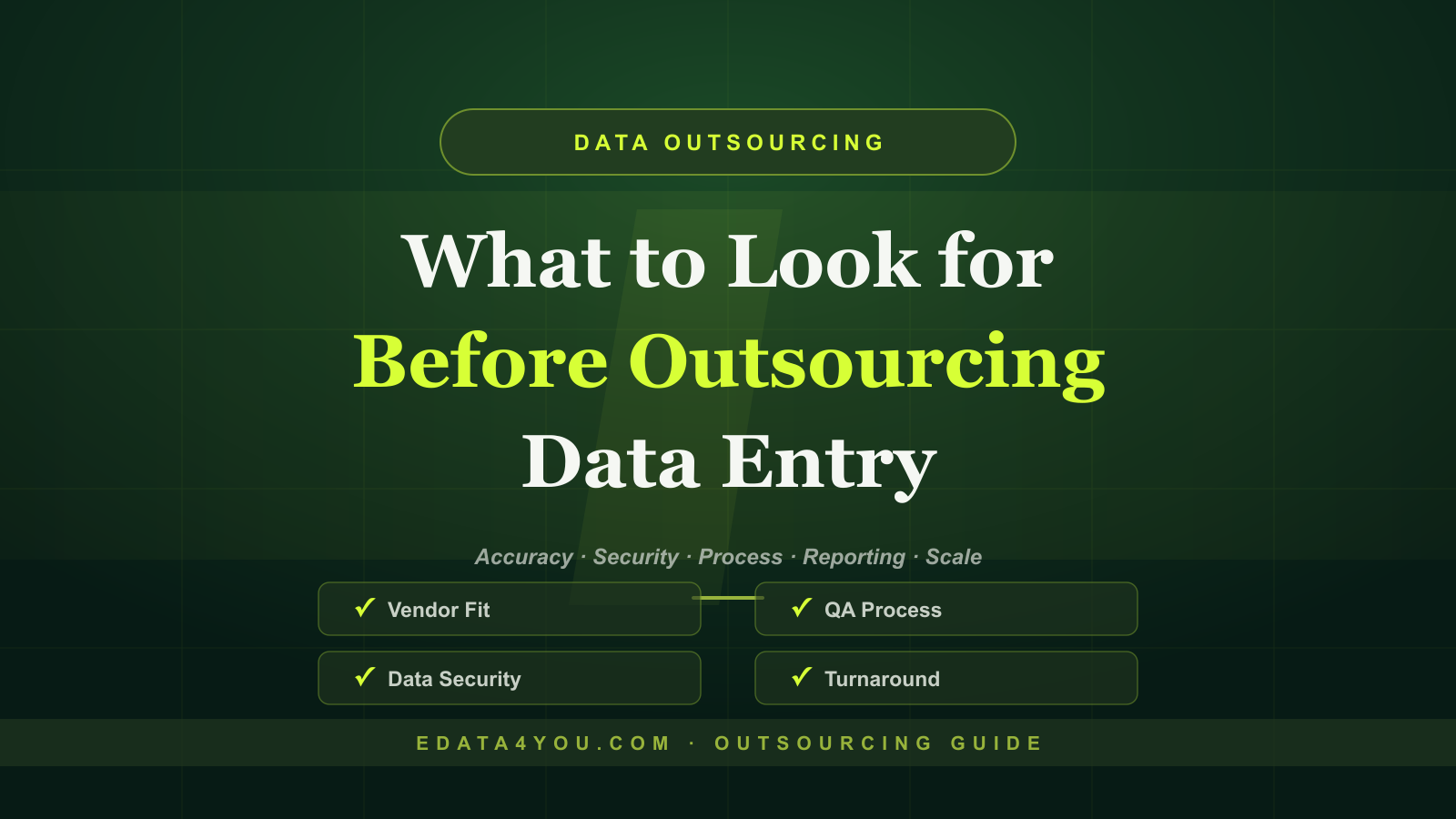
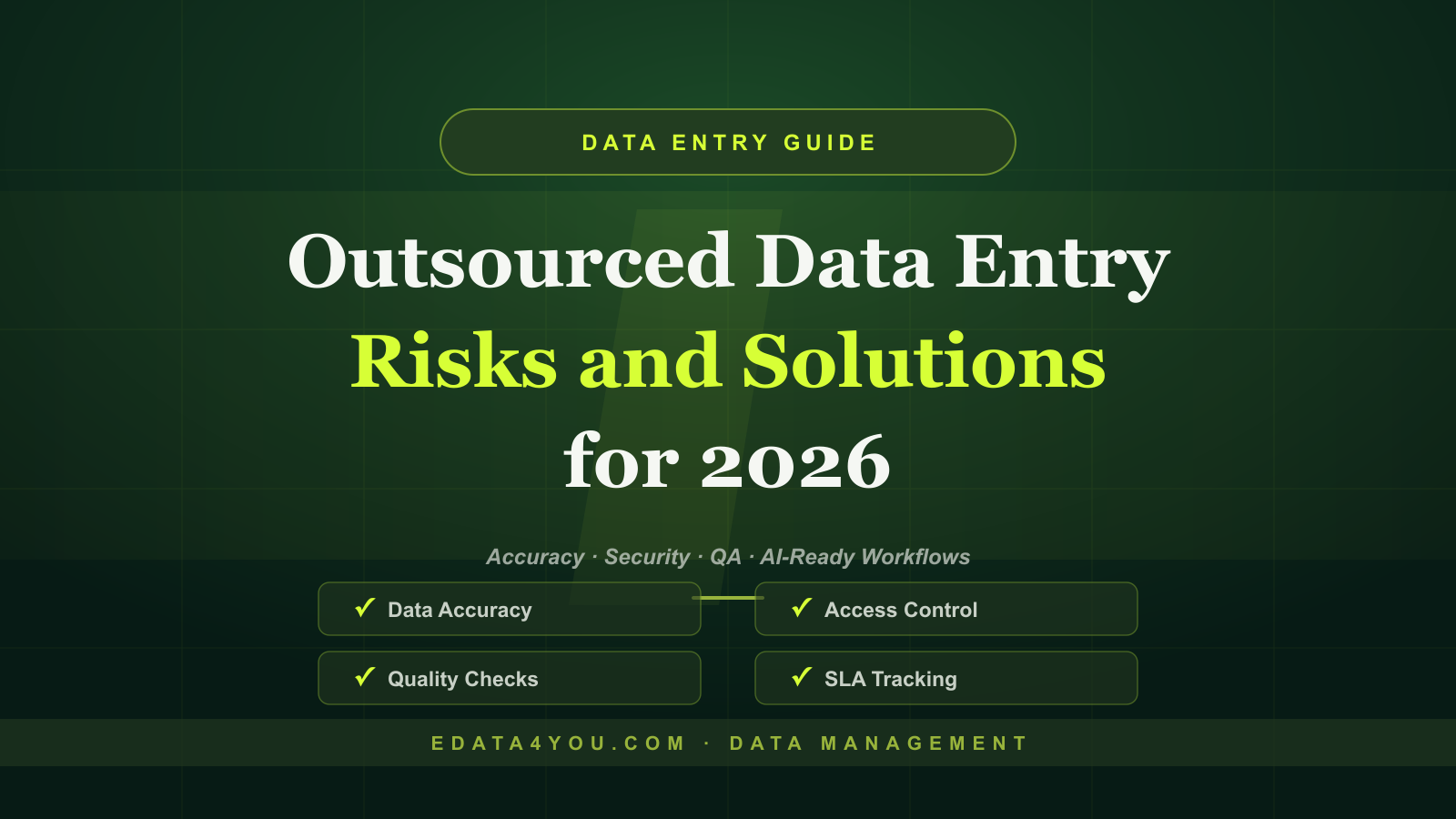
Before outsourcing data entry projects, evaluate the provider's accuracy rates, QA process, data security practices, turnaround reliability, and experience with your specific type of data. A provider who performs well on all five criteria is worth more than a cheaper option that fails on any one of them.
Outsourcing data entry to the wrong provider creates problems that cost more to fix than the original work cost to do. Inaccurate records, missed deadlines, and data security incidents all carry real business consequences. This guide covers the criteria that matter most when evaluating providers and the red flags that signal a poor fit.
Accuracy Rate and Quality Control Process
Accuracy is the most important criterion for data entry work. A provider with a 95 percent accuracy rate sounds acceptable until you realize that means 1 in 20 records has an error. For a catalog of 10,000 products, that is 500 incorrect entries.
Ask every provider how they measure and guarantee accuracy. The answer should describe a specific QA process, not a vague commitment to quality.
What a Strong QA Process Looks Like
The best providers use double-entry verification: two operators enter the same data independently, and the system flags any mismatch for review. Others use automated validation to check data formats, required fields, and range constraints before delivery.
You should receive output with a stated accuracy guarantee, typically 99 percent or higher for structured data, and a clear remediation process for errors found after delivery. If a provider cannot describe their QA process in specific terms, treat that as a warning sign.
Data Security and Confidentiality Practices
Data entry work often involves sensitive information: customer records, financial data, supplier pricing, unreleased product information, or proprietary catalog content. Before sharing any of that with a provider, understand exactly how they protect it.
Security Questions to Ask Every Provider
- Do they sign a Non-Disclosure Agreement before the project starts?
- Is data transferred over encrypted channels?
- Who within their organization has access to your files?
- How is data stored during the project, and is it deleted after delivery?
- Do they comply with GDPR, ISO 27001, or other relevant data protection standards?
A provider who cannot answer these questions clearly is a risk. Reputable providers have documented security policies and will share them on request.
Experience With Your Type of Data
Data entry is not a single skill. Processing product catalog data for ecommerce requires different knowledge than entering insurance claims, medical records, or legal documents. A provider experienced in one area may produce poor results in another.
Ask specifically about their experience with your data type. Request examples of similar work or client references in your industry. If a provider claims to handle all types of data equally well, ask for specific volume figures and error rates from clients in your category.
For ecommerce catalog work, look for experience with Amazon, Shopify, Walmart, or whichever platforms you sell on. Platform-specific knowledge significantly reduces errors and rework.
Turnaround Time and Reliability
A provider who delivers accurate data two weeks late is not useful when your launch date is next week. Turnaround reliability matters as much as accuracy for time-sensitive projects.
How to Test Turnaround Before Committing
Ask for their standard turnaround on a project similar to yours. Then run a paid pilot batch, not a free sample, and measure whether they deliver on time. Free samples are often handled differently from paid work.
Check whether they have buffer capacity to handle volume spikes. If your monthly data entry volume doubles for a product launch, can they absorb that increase with the same turnaround? Get that answer in writing before it becomes urgent.
Turn these recommendations into a working process with Virtual Assistant Services.
Pricing Structure and What Is Included
Data entry pricing varies widely. Some providers charge per record, others per hour, and others by project. The right structure depends on your volume and task complexity.
| Pricing Model | Best For | Watch Out For |
|---|---|---|
| Per record | Structured, predictable tasks | Hidden fees for complex records |
| Per hour | Variable or research-heavy tasks | Inflated time without output benchmarks |
| Per project | Defined scope, one-time tasks | Scope creep that increases cost |
| Monthly retainer | Ongoing steady-volume work | Underutilized capacity in slow months |
Always clarify what is included in the quoted rate. QA passes, revisions, secure file transfer, and project management are sometimes billed separately. Get a written scope of work before signing.
Communication and Project Management
Poor communication is one of the most common complaints about outsourced data entry. Slow responses, unclear escalation paths, and no visibility into project status all create frustration and risk.
Evaluate communication before you start a project. How quickly do they respond to inquiries? Do they assign a single point of contact? What project management tools do they use? Can you see status updates in real time or only when you ask?
A provider who is responsive and transparent during the sales process is more likely to remain that way once the project is running.
Scalability for Future Needs
Your data volume today may look very different in six months. If you are growing, entering new markets, or expanding your product catalog, your provider needs to scale with you.
Ask about their team size, their maximum monthly output, and how they handle requests that exceed their current capacity. A small provider who is efficient now may become a bottleneck when your volume grows.
Red Flags to Avoid
Some providers look capable on the surface but show warning signs under scrutiny. Watch for:
- Unwillingness to sign an NDA before discussing your data
- No specific accuracy guarantee or QA process description
- Turnaround promises that seem too fast for the stated volume
- Pricing significantly lower than market rates without a clear explanation
- No client references willing to speak on their behalf
- Vague responses to direct security questions
Any one of these is worth pausing on. More than one is a signal to look elsewhere.
Running a Pilot Before Full Commitment
The most reliable way to evaluate a data entry provider is to run a paid pilot on a real sample of your work. Give them 100 to 500 records that represent your typical complexity, provide your standard instructions, and evaluate accuracy, formatting, turnaround, and communication.
A pilot tells you more than any sales conversation can. It shows how the provider performs under real conditions with real data, not a curated sample designed to impress.
If the pilot results are strong, scale up with confidence. If results are inconsistent, you have learned that without committing your full volume.
Finding a Provider That Fits Your Requirements
The right outsourced data entry provider for your business is one who matches your accuracy standards, works within your timelines, secures your data properly, and communicates clearly throughout the project.
eData4You provides data entry and catalog processing services for ecommerce businesses and B2B operations. Our QA process uses double-entry verification and structured review at every stage. We work with brands across Amazon, Shopify, Walmart, and other major platforms. Request a free consultation to discuss your project and receive a detailed proposal.
Let's build something great together
A dedicated team of ecommerce, design, and data specialists - ready to scale your business across every marketplace.
Recent Posts
Latest on Social
Grow your sales on Amazon, Walmart & more
Our marketplace specialists handle listings, SEO, catalog & ads - end to end.
Talk to an Expert
Amit Sharma
Founder & IT Head | Project Management & IT Strategy Expert
Leave a Comment