

Quick answer
What you need to know
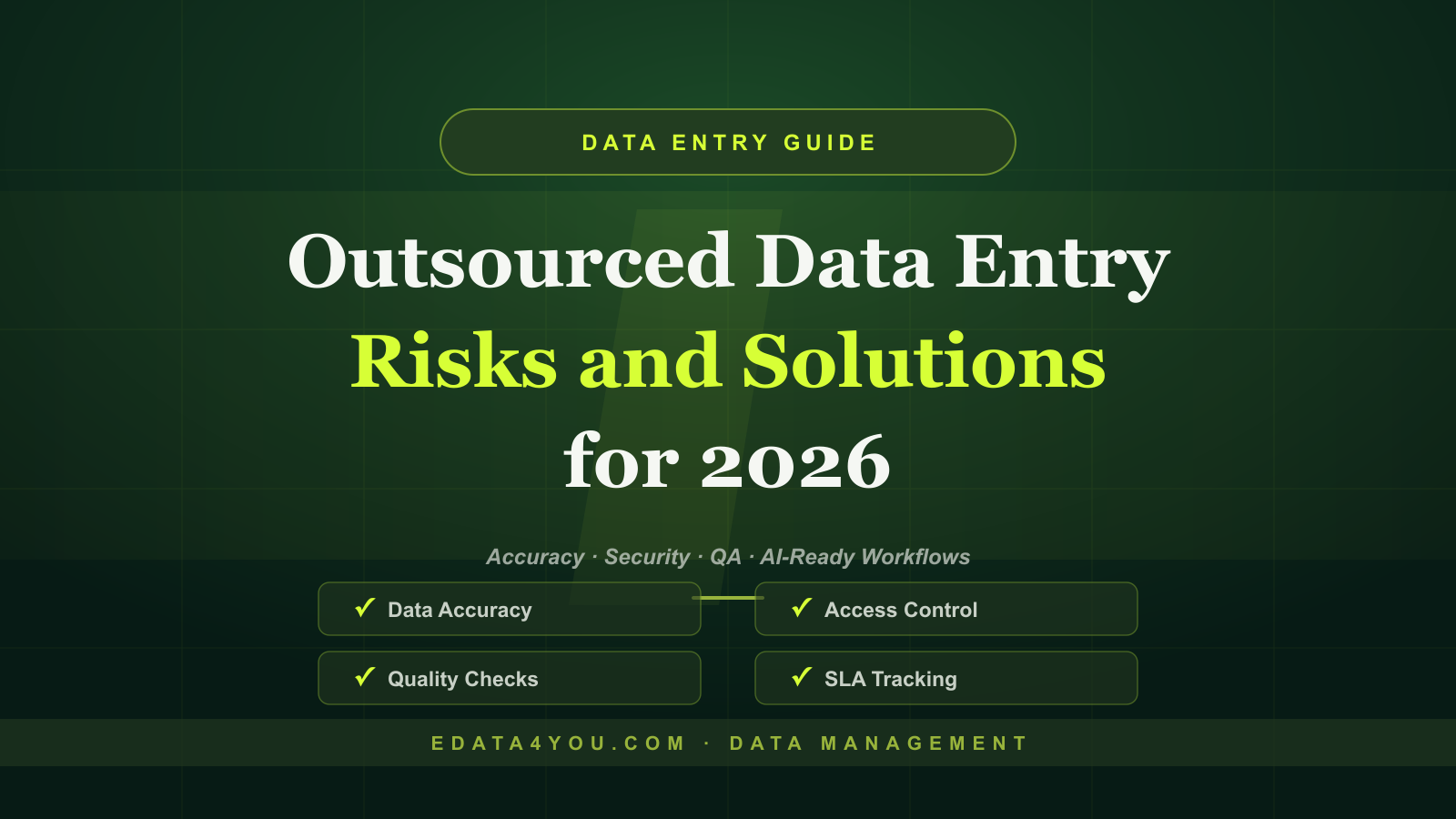
Outsourcing data entry carries real risks around accuracy, security, and turnaround reliability. Here is how to identify them before they become problems and how to solve them when they do.
What Are the Main Risks of Outsourcing Data Entry?
Risk 1: Inaccurate Data Delivered at Scale
Risk 2: Data Security and Confidentiality Failures
Premium reader tools
Turn insight into action
The brief, before you dive in
A practical snapshot of what this guide will help you understand and apply.
Key takeaways
- What Are the Main Risks of Outsourcing Data Entry?: The main risks of outsourcing data entry are poor accuracy, data security breaches, unreliable turnaround times, and insufficient vendor communication…
- Risk 1: Inaccurate Data Delivered at Scale: Accuracy is the most critical requirement in data entry.
- Risk 2: Data Security and Confidentiality Failures: Data entry providers access your business data to do their work.
- Risk 3: Missed Deadlines and Unreliable Turnaround: Data entry delays create cascading problems.
Need help applying this? Explore our Product Data Management.
What Are the Main Risks of Outsourcing Data Entry?
The main risks of outsourcing data entry are poor accuracy, data security breaches, unreliable turnaround times, and insufficient vendor communication. Each of these can be managed with the right contract structure, vendor selection process, and ongoing quality checks, but they cannot be ignored.
Many businesses discover these risks after they have already committed to a provider. This guide explains each risk clearly, describes what causes it, and gives you specific steps to address it before or after it appears.
Risk 1: Inaccurate Data Delivered at Scale
Accuracy is the most critical requirement in data entry. When errors are introduced at the entry stage, they propagate through your systems and become increasingly expensive to find and correct.
What Causes Accuracy Problems
- Operators working without clear instructions or templates
- No double-entry verification or QA step before delivery
- High operator turnover with inconsistent training
- Vague error definitions that allow substandard work to pass review
- Pressure to prioritize speed over accuracy
How to Solve It
Require a documented QA process from any provider before you sign a contract. Double-entry verification, where two operators independently enter the same record and the system flags mismatches, is the minimum standard for structured data tasks.
Specify your accuracy requirement in the contract. For most structured data entry, 99 percent or higher is achievable and should be the stated standard. Include a clear remediation process: what happens when errors exceed the agreed threshold, how quickly corrections are delivered, and who absorbs the cost.
Run a paid pilot on a real sample of your data before committing full volume. Pilots reveal actual accuracy levels under real conditions, not the performance figures from a sales presentation.
Risk 2: Data Security and Confidentiality Failures
Data entry providers access your business data to do their work. That access creates exposure risk, especially when the data includes customer records, supplier pricing, unreleased product information, or financial documents.
What Causes Security Problems
- No formal NDA or data processing agreement before project start
- Weak access controls that allow unnecessary team members to view files
- Unencrypted file transfer over email or unsecured channels
- No policy for data retention and deletion after project completion
- Providers who subcontract work to third parties without disclosure
How to Solve It
Require a signed NDA and data processing agreement before sharing any files. Specify how data will be transferred (encrypted channels such as SFTP), who within the provider's organization will have access, how data will be stored during the project, and when it will be deleted after delivery.
Ask about their security certifications. ISO 27001 and SOC 2 Type II are the most relevant standards for data entry providers handling business information. If a provider cannot produce documentation of their security practices, treat that as a disqualifying issue.
Provide only the data needed for the specific task. Avoid sharing full databases when a filtered export would suffice.
Risk 3: Missed Deadlines and Unreliable Turnaround
Data entry delays create cascading problems. Product launches wait for catalog data. Reporting waits for financial records. Fulfillment waits for order data updates. When your provider misses a deadline, it is rarely just an inconvenience.
What Causes Turnaround Failures
- Provider over-committing to multiple clients simultaneously
- No buffer capacity for volume spikes or complex records
- Operator sick leave or turnover creating unplanned gaps
- Miscommunication about what was agreed vs. what was delivered
How to Solve It
Confirm realistic turnaround expectations before signing. Ask specifically: what is the maximum volume they can process within your required timeline? What happens when a batch arrives larger than expected?
Include turnaround commitments in the contract with clear consequences for repeated failures. A service level agreement (SLA) that specifies delivery times and defines what happens when they are missed creates accountability.
Test turnaround during a pilot. Give the provider a realistic volume with a realistic deadline, and measure whether they hit it consistently over multiple batches.
Turn these recommendations into a working process with Product Data Management.
Risk 4: Communication Gaps and Project Visibility
Poor communication with an outsourced provider creates uncertainty, delays, and errors. When you do not know the status of a project, you cannot manage downstream dependencies that rely on that data.
What Causes Communication Problems
- No dedicated point of contact for your account
- Slow response times due to time zone differences or high workload
- No project management system that gives you visibility into progress
- Ambiguous instructions that generate questions instead of output
How to Solve It
Require a dedicated account contact before the project starts. Establish expected response times for questions and status updates, and include those in your contract.
Provide complete, written instructions for every project before work begins. A well-documented data template with examples, field definitions, and edge case guidance generates far fewer questions than a verbal briefing.
Ask what project management tools the provider uses and whether you will have access to a shared workspace where you can see progress in real time rather than waiting for updates.
Risk 5: Vendor Lock-In and Transition Difficulty
Some businesses become dependent on a single data entry provider and find it difficult to switch when quality drops or pricing increases. Lock-in happens when a provider holds your data, your process documentation, or both.
How to Prevent Vendor Lock-In
Maintain your own process documentation rather than relying solely on the provider to document how your data tasks are handled. Store all delivered output in systems you control. Ensure your data can be exported in a standard format at any time.
Structure contracts with reasonable exit clauses. Notice periods of 30 to 60 days are standard for ongoing data entry relationships and give you time to transition without operational disruption.
A Quality Control Checklist for Outsourced Data Entry
Before committing volume to any provider, confirm:
- Documented accuracy rate with QA process description
- Double-entry verification or equivalent validation method
- Signed NDA and data processing agreement
- Encrypted file transfer and defined access controls
- Written turnaround commitments in a contract or SLA
- Dedicated point of contact with defined response times
- Pilot batch completed and reviewed before full volume begins
- Clear remediation process for errors above the agreed threshold
- Your own copy of all process documentation
- Exit clause with reasonable notice period
Managing Risk Through the Vendor Relationship
The risks of outsourced data entry do not disappear after you select a good provider. They require ongoing management: regular QA review of delivered output, periodic check-ins on capacity and performance, and clear escalation when issues appear.
Treat your data entry provider as an operational partner rather than a transaction. Providers who receive specific feedback, clear instructions, and fair treatment tend to perform better over time and prioritize your account when capacity is constrained.
eData4You provides data entry and catalog processing services with documented QA at every stage. We use double-entry verification, structured output review, and defined accuracy guarantees on all standard data entry work. Request a free consultation to discuss your data requirements and how we approach quality control.
Let's build something great together
A dedicated team of ecommerce, design, and data specialists - ready to scale your business across every marketplace.
Recent Posts
Latest on Social
Grow your sales on Amazon, Walmart & more
Our marketplace specialists handle listings, SEO, catalog & ads - end to end.
Talk to an Expert
Amit Sharma
Founder & IT Head | Project Management & IT Strategy Expert
Leave a Comment