

Quick answer
What you need to know
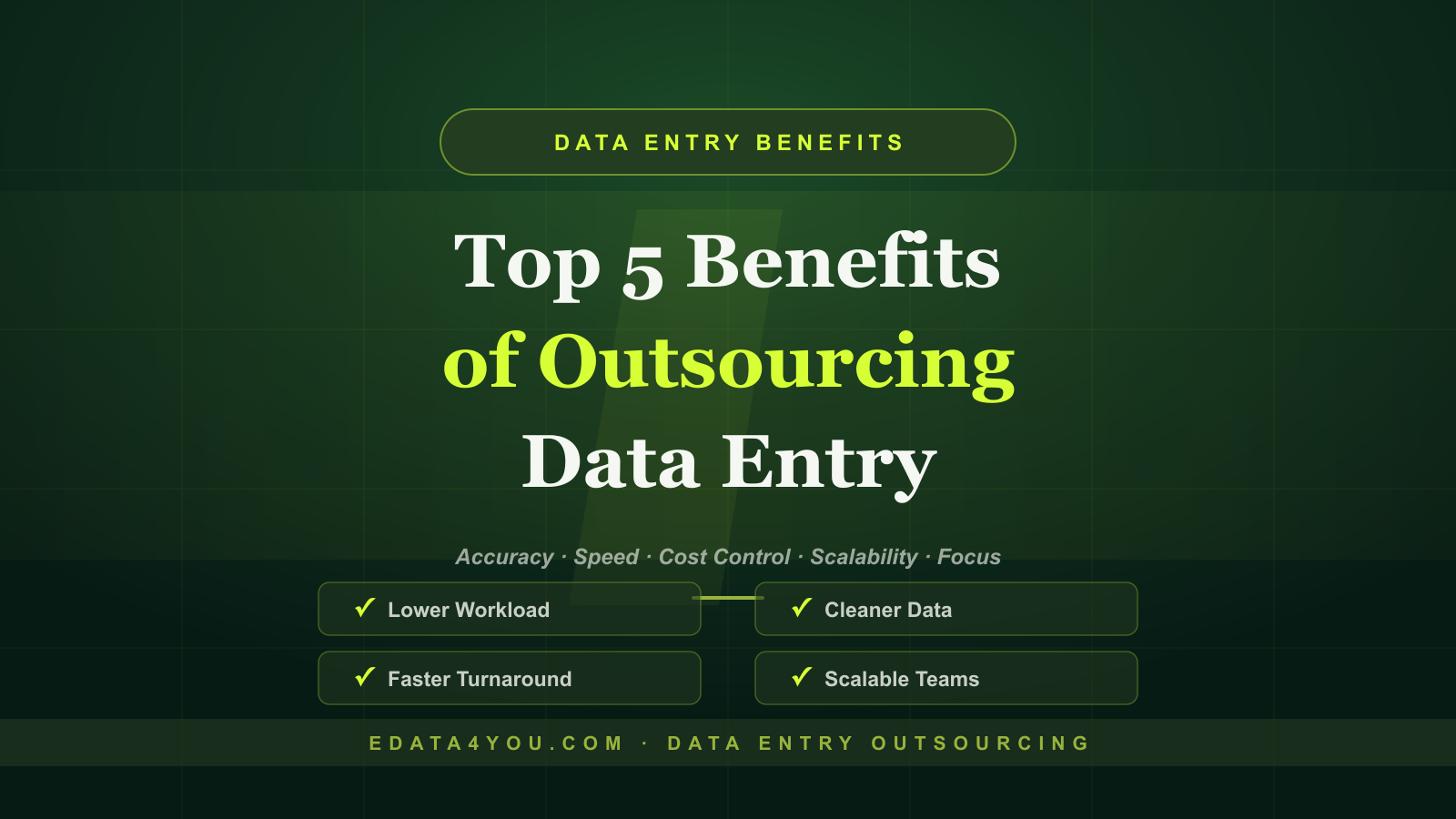
Outsourcing data entry cuts costs, improves accuracy, speeds up turnaround, and frees your team to focus on work that grows revenue. Here are the five benefits that matter most.
What Are the Main Benefits of Outsourcing Data Entry?
Lower Operating Costs Without Sacrificing Output
Higher Accuracy Through Dedicated QA Workflows
Premium reader tools
Turn insight into action
The brief, before you dive in
A practical snapshot of what this guide will help you understand and apply.
Key takeaways
- What Are the Main Benefits of Outsourcing Data Entry?: Outsourcing data entry reduces operating costs, improves data accuracy, and frees your internal team to focus on higher-value tasks.
- Lower Operating Costs Without Sacrificing Output: The most immediate benefit of outsourcing data entry is cost reduction.
- Higher Accuracy Through Dedicated QA Workflows: Internal teams juggling multiple responsibilities make more errors than dedicated data entry specialists.
- Faster Turnaround on High-Volume Tasks: A small internal team has a fixed processing capacity.
Need help applying this? Explore our Virtual Assistant Services.
What Are the Main Benefits of Outsourcing Data Entry?
Outsourcing data entry reduces operating costs, improves data accuracy, and frees your internal team to focus on higher-value tasks. For most businesses, it is also the fastest way to scale data processing without hiring permanent staff.
Data entry is one of the most time-consuming back-office tasks in any operation. Product uploads, invoice processing, customer records, order management, and catalog updates all require consistent effort and attention to detail. When that work sits on your team's plate, it competes with client work, sales, and growth projects.
This guide breaks down the five benefits that businesses consistently report after moving data entry to an outsourced provider.
Lower Operating Costs Without Sacrificing Output
The most immediate benefit of outsourcing data entry is cost reduction. Hiring full-time data entry staff means paying salaries, benefits, office space, equipment, and training. An outsourced provider packages all of those costs into a predictable per-task or per-hour rate.
For most businesses, the savings range from 40 to 70 percent compared to in-house staffing, depending on volume and complexity. That gap is larger when you account for recruitment time and the cost of turnover.
What Does Cost Reduction Actually Look Like?
A company processing 5,000 product records per month might pay an internal data entry staff member a monthly salary plus overhead. An outsourced provider handling the same volume charges only for the work delivered. There is no idle time, no sick leave, and no benefits administration.
Offshore providers in India offer particularly competitive pricing for high-volume, structured work without compromising output quality when proper QA systems are in place.
Higher Accuracy Through Dedicated QA Workflows
Internal teams juggling multiple responsibilities make more errors than dedicated data entry specialists. Fatigue, context-switching, and lack of specialized training all contribute to mistakes that accumulate in your systems over time.
Professional data entry providers use double-entry verification, automated validation, and structured quality checks at every stage. Error rates at established providers typically fall below one percent for structured data tasks.
How Do Providers Maintain Accuracy at Scale?
Most providers use a combination of human review and software validation. Each record is entered twice by different operators and compared for mismatches. Exceptions are flagged and reviewed before delivery.
For ecommerce catalogs, accuracy checks cover product titles, attributes, pricing, category mapping, and image assignment. A single incorrect attribute can cause a product to disappear from search results or display incorrectly on a marketplace, which directly affects sales.
Faster Turnaround on High-Volume Tasks
A small internal team has a fixed processing capacity. When volume spikes, such as during a catalog expansion, a seasonal product launch, or a marketplace migration, that team hits a wall.
Outsourced providers scale capacity on demand. A provider with a trained team of 50 operators can process in one day what a team of three would take two weeks to complete.
When Does Faster Turnaround Create Business Value?
Speed matters most when data delays block other parts of the business. If your development team cannot launch a new product category until the catalog is complete, or your sales team cannot quote accurately until the price list is updated, slow data entry has a direct revenue cost.
Outsourcing removes that bottleneck. Most providers offer 24 to 72 hour turnarounds on structured tasks, with rush options for time-sensitive projects.
Turn these recommendations into a working process with Virtual Assistant Services.
Scalable Capacity Without Hiring Cycles
Hiring for peak demand means carrying excess cost during slower periods. Outsourcing gives you capacity that scales up and down with your actual volume.
This is particularly valuable for ecommerce businesses with seasonal patterns. A retailer who needs 10,000 products entered before a holiday season and 500 per month the rest of the year cannot justify permanent staff for that peak.
How Does Scalable Outsourcing Work in Practice?
You agree on a base volume with your provider and communicate upcoming spikes in advance. Most providers can accommodate two to five times normal volume with a few days of notice. That flexibility removes the pressure to over-hire or to delay projects until internal capacity clears.
For growing businesses, scalability also means you are not limited by your team's current size when pursuing new contracts, market expansions, or platform migrations.
Your Team Focuses on Work That Grows Revenue
Data entry is necessary work, but it does not generate revenue on its own. When your internal team spends hours on data tasks, those are hours not spent on product strategy, client relationships, marketing, or business development.
Outsourcing moves the operational burden out of your core team's day. The result is not just time saved but a shift in what your people are working on.
What Tasks Open Up When Data Entry Is Outsourced?
In ecommerce businesses, outsourcing catalog work typically frees product managers to focus on pricing strategy, supplier relationships, and new category development. In B2B companies, it frees operations teams to focus on process improvement and client delivery.
The compounding effect is significant. A team that recovers ten hours per week of focused work can take on an additional client, build new systems, or complete projects that have been stalled for months.
What Types of Data Entry Tasks Are Best Suited for Outsourcing?
Not all data tasks are equal. The best candidates for outsourcing are tasks that are structured, repeatable, and clearly defined. These include:
- Product catalog entry and attribute mapping
- Invoice and purchase order processing
- Customer record updates and CRM data entry
- Order management and shipment tracking updates
- Market research data compilation
- Survey and form response processing
- Image tagging and alt text entry
Tasks that require business judgment, real-time decision-making, or deep institutional knowledge are better kept in-house. Outsourcing works best when the process can be documented and handed off with clear instructions.
How to Get the Most Out of an Outsourced Data Entry Partnership
Outsourcing works best when you treat the provider as a process partner, not just a task executor. That means providing clear data templates, documenting your quality standards, and establishing a feedback loop for errors.
Start with a pilot batch to verify accuracy and turnaround before committing high-volume work. Build a process guide that covers your data format, naming conventions, category structure, and common edge cases. Review output regularly during the first few weeks to catch any misalignment early.
Providers who specialize in your industry, whether ecommerce, healthcare, finance, or logistics, will require less ramp-up time and deliver more consistent results.
Is Outsourcing Data Entry Right for Your Business?
Outsourcing data entry makes sense for any business where the volume of structured data tasks is large enough to create a consistent workload. If your team spends more than five hours per week on data entry, that work is almost certainly cheaper and faster to outsource.
The five benefits above, lower cost, higher accuracy, faster turnaround, scalable capacity, and freed internal focus, compound over time. Businesses that make the switch typically see the results within the first month.
eData4You provides data entry and catalog processing services for ecommerce brands, retailers, and marketplace sellers. Our teams handle product data, order records, and catalog updates with structured QA at every stage. Request a free consultation to discuss your data volume and turnaround requirements.

Let's build something great together
A dedicated team of ecommerce, design, and data specialists - ready to scale your business across every marketplace.
Recent Posts
Latest on Social
Grow your sales on Amazon, Walmart & more
Our marketplace specialists handle listings, SEO, catalog & ads - end to end.
Talk to an Expert
Amit Sharma
Founder & IT Head | Project Management & IT Strategy Expert
Leave a Comment