

Quick answer
What you need to know
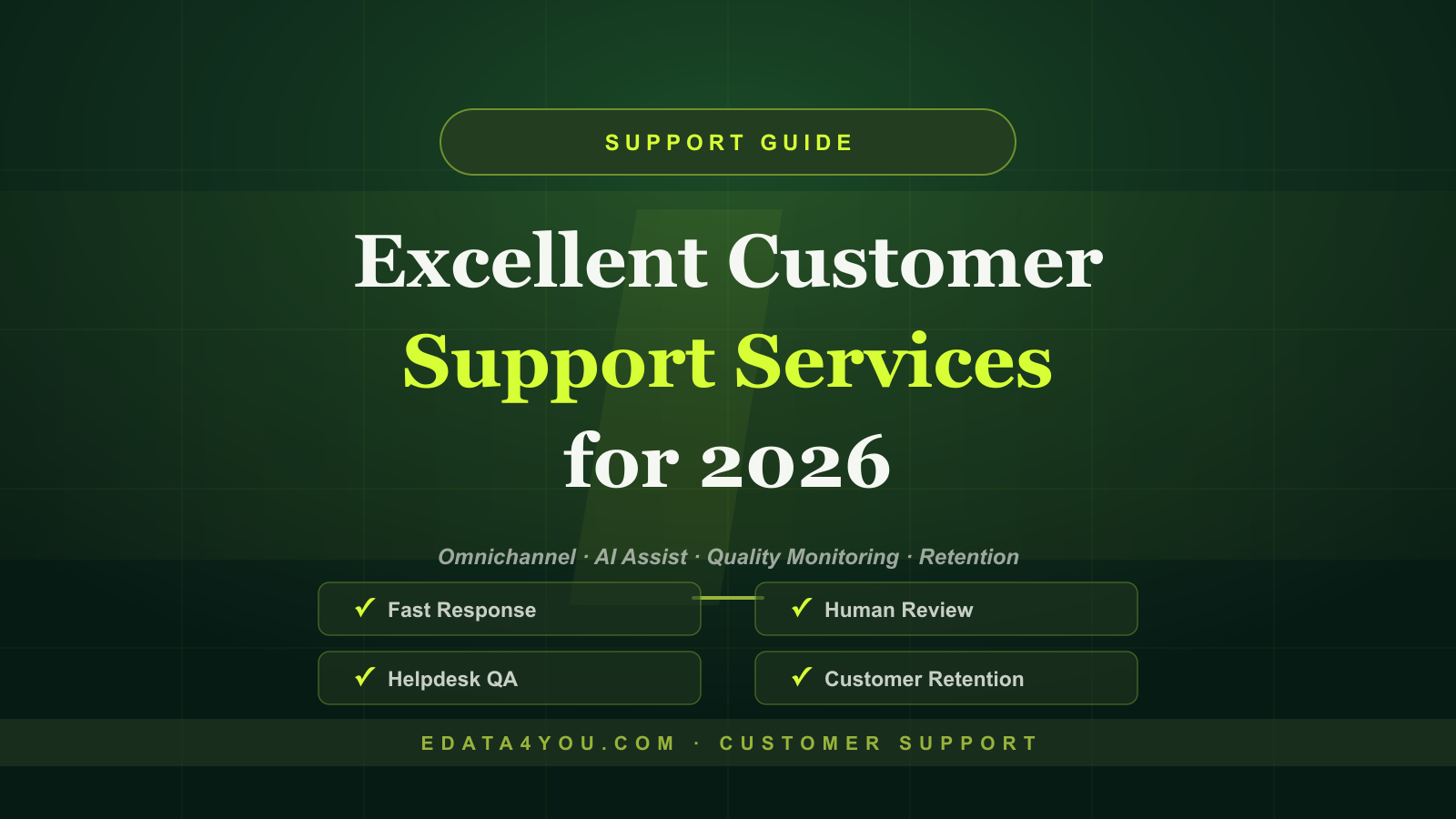
Excellent customer support services keep buyers returning and reduce costly returns and chargebacks. Here is a practical guide to building support that works at scale.
What Makes Customer Support Services Excellent?
Why Response Time Is the Foundation of Good Support
Building a Knowledge Base That Reduces Ticket Volume
Premium reader tools
Turn insight into action
The brief, before you dive in
A practical snapshot of what this guide will help you understand and apply.
Key takeaways
- What Makes Customer Support Services Excellent?: Excellent customer support services resolve issues quickly, communicate clearly, and give buyers confidence that problems will be fixed without fricti…
- Why Response Time Is the Foundation of Good Support: Response time is the single factor buyers cite most often when evaluating support quality.
- Building a Knowledge Base That Reduces Ticket Volume: The most efficient way to handle support is to answer questions before they become tickets.
- What Agent Training Must Cover: Support agents who lack product knowledge and policy clarity give inconsistent responses.
Need help applying this? Explore our Virtual Assistant Services.
What Makes Customer Support Services Excellent?
Excellent customer support services resolve issues quickly, communicate clearly, and give buyers confidence that problems will be fixed without friction. For ecommerce businesses, support quality directly affects repeat purchase rates, review scores, and return volumes.
Most buyers do not complain to the business when they have a poor support experience. They leave a negative review, file a chargeback, or simply never order again. The cost of poor customer support is largely invisible in the short term and very expensive over time.
This guide covers the operational components of high-quality customer support, from response time standards and agent training to QA processes and the decision of whether to build in-house or outsource.
Why Response Time Is the Foundation of Good Support
Response time is the single factor buyers cite most often when evaluating support quality. A buyer who receives a response within two hours has a very different experience from one who waits two days, even if the resolution in both cases is identical.
What Response Time Standards Should You Target?
For ecommerce support, these benchmarks represent competitive standards in 2026:
| Channel | Target First Response Time |
|---|---|
| Email or ticket | Under 4 hours |
| Live chat | Under 2 minutes |
| Social media DM | Under 2 hours |
| Phone | Under 3 minutes wait |
| Marketplace messaging (Amazon, eBay) | Under 24 hours |
Amazon penalizes sellers whose response rate to buyer messages falls below 90 percent within 24 hours. Meeting that threshold is a baseline requirement, not a standard to aspire to.
Building a Knowledge Base That Reduces Ticket Volume
The most efficient way to handle support is to answer questions before they become tickets. A well-structured knowledge base covering common questions, order processes, return policies, and product details reduces incoming volume significantly.
What to Include in an Ecommerce Knowledge Base
- Order tracking and delivery timeframes
- Return and refund policy with step-by-step instructions
- Product size guides, compatibility charts, and care instructions
- Payment methods accepted and how to update payment information
- How to contact support and what response times to expect
- Common troubleshooting steps for product issues
Knowledge base content should be written in plain language, organized by category, and reviewed quarterly to ensure it reflects current policies and products. Outdated knowledge base content creates more confusion than no knowledge base at all.
What Agent Training Must Cover
Support agents who lack product knowledge and policy clarity give inconsistent responses. Inconsistent responses frustrate buyers and create additional tickets as buyers follow up to get a straight answer.
Core Training Areas for Ecommerce Support Agents
Product knowledge: Agents need to understand what you sell, how products work, common compatibility questions, and how to identify which product a buyer purchased from an order reference.
Policy knowledge: Return windows, refund processing times, exchange procedures, and escalation paths for damaged or missing orders should all be documented and tested during training.
Tone and communication standards: Define how agents should open and close conversations, how to handle frustrated buyers, and what language is off-limits. Written standards reduce variation across agents significantly.
Escalation protocol: Agents need to know immediately when to escalate an issue to a senior team member or a manager, and how to communicate that escalation to the buyer without creating additional frustration.
Platform tools: Agents should be trained on the ticketing system, order management platform, and any marketplace portals they use before handling live tickets.
Turn these recommendations into a working process with Virtual Assistant Services.
Setting Up Omnichannel Support Without Creating Chaos
Buyers contact support through email, live chat, social media, marketplace messaging, and sometimes phone. Managing these channels separately creates gaps where tickets fall through and buyers have to repeat themselves.
A unified helpdesk platform brings all channels into a single queue. Agents see the full conversation history regardless of which channel the buyer used, which eliminates the frustration of repeated explanations. Popular platforms for ecommerce support operations include Zendesk, Freshdesk, Gorgias (which connects directly to Shopify), and Re:amaze.
Channel coverage does not need to mean 24-hour availability on every platform from day one. Start with the channels your buyers use most, cover those well, and add capacity as volume grows.
Quality Assurance for Customer Support
Support quality degrades without a structured review process. Agents develop shortcuts, tone slips, and response accuracy drops, especially on high-volume days.
How to Build a Support QA Process
Review a sample of closed tickets weekly: aim for 5 to 10 percent of total volume, or at minimum 20 tickets per agent per month. Score each ticket on:
- Response accuracy (was the information given correct?)
- Response clarity (would a first-time buyer understand it?)
- Policy adherence (did the agent follow procedures correctly?)
- Tone (was the response appropriate for the situation?)
- Resolution (was the issue actually resolved, or was it closed prematurely?)
Share individual feedback with agents in a structured review session, not in front of the team. Track scores over time to identify whether training gaps are improving or persisting.
When to Outsource Customer Support Services
Outsourcing customer support makes sense when internal teams cannot keep pace with volume, when coverage hours need to extend beyond what in-house staffing can sustain, or when the cost of building internal capacity outweighs the cost of an external provider.
What to Evaluate in a Support Outsourcing Provider
Before selecting a provider, assess:
- Experience with your platform (Shopify, Amazon, eBay, or other)
- Language capability matching your customer base
- Staffing flexibility for volume spikes
- Technology compatibility with your existing helpdesk
- QA process and how they report performance metrics
- References from ecommerce clients with similar volumes
A pilot period of 30 to 60 days before full commitment allows you to assess accuracy, tone, and ticket resolution quality under real conditions.
Common Support Problems That Kill Retention
- Slow first responses that leave buyers anxious about their order
- Agents giving different answers to the same question on different days
- Ticket closures without confirming the issue was resolved
- Automated replies that do not answer the actual question
- Refund or return processes that require too many steps to complete
- No follow-up on escalated issues, leaving buyers with no update
Each of these erodes buyer confidence. The buyers who have bad support experiences and never come back are the ones you never hear from, which makes the problem easy to underestimate.
Building Customer Support That Scales
The businesses that consistently receive strong reviews and maintain high marketplace seller ratings do not have unusually talented support agents. They have clear processes, documented policies, structured training, and regular QA review.
Support at scale requires investment in systems and process, not just in headcount. The right helpdesk platform, a complete knowledge base, documented escalation paths, and a regular quality review cycle are the components that make support reliable as volume grows.
eData4You provides customer support outsourcing for ecommerce businesses on Amazon, Shopify, eBay, and other platforms. Our teams handle ticket management, buyer communication, returns coordination, and marketplace messaging with structured QA at every stage. Request a free consultation to discuss your support volume and coverage requirements.
Let's build something great together
A dedicated team of ecommerce, design, and data specialists - ready to scale your business across every marketplace.
Recent Posts
Latest on Social
Grow your sales on Amazon, Walmart & more
Our marketplace specialists handle listings, SEO, catalog & ads - end to end.
Talk to an Expert
Amit Sharma
Founder & IT Head | Project Management & IT Strategy Expert
Leave a Comment