

Quick answer
What you need to know
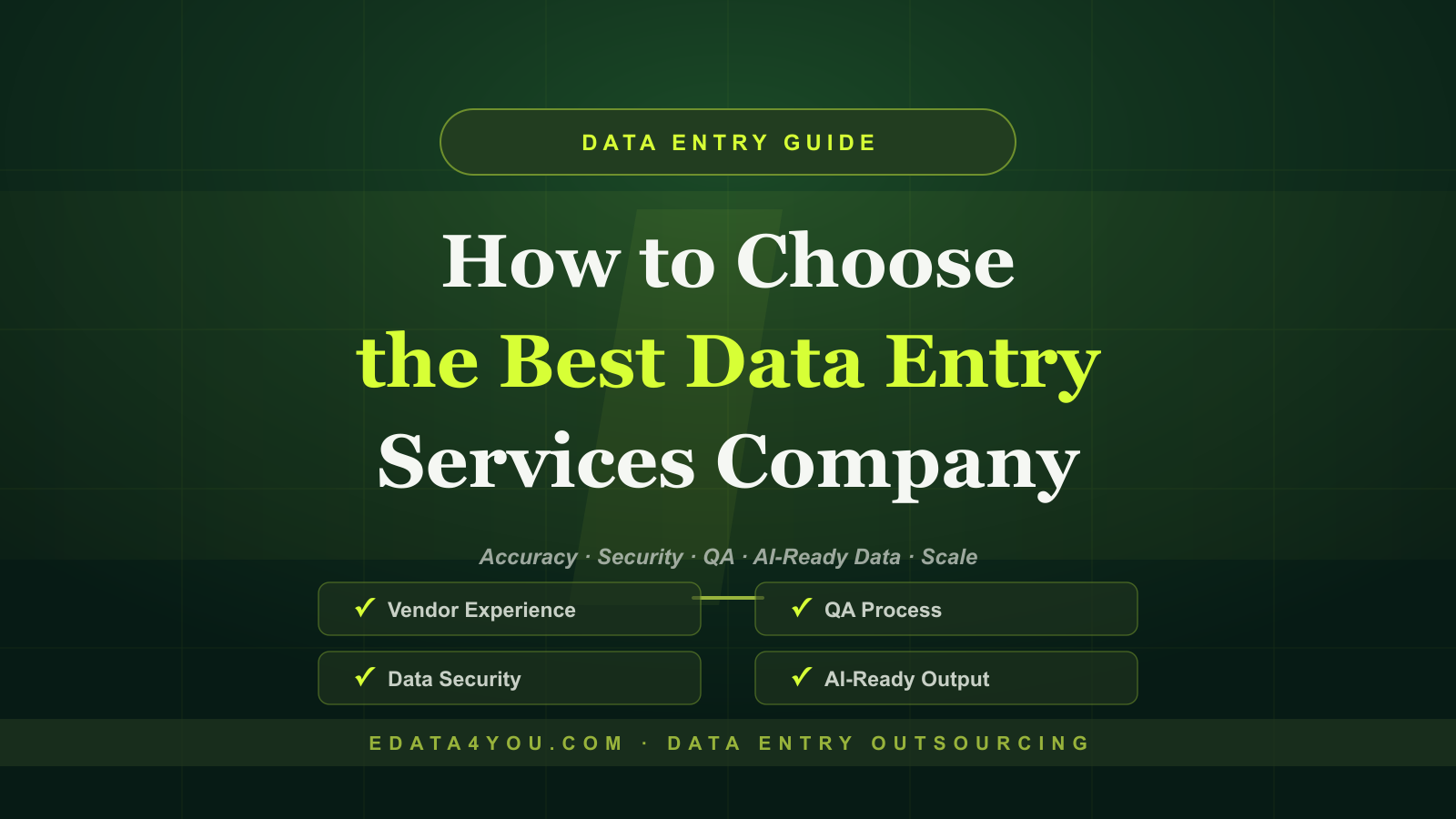
The best data entry services company is not always the cheapest one. Here is a step-by-step framework for evaluating providers on accuracy, security, speed, and fit.
How Do You Choose the Best Data Entry Services Company?
Step 1: Define What You Actually Need
Step 2: Evaluate Accuracy and the QA Process
Premium reader tools
Turn insight into action
The brief, before you dive in
A practical snapshot of what this guide will help you understand and apply.
Key takeaways
- How Do You Choose the Best Data Entry Services Company?: The best data entry services company for your business is one that matches your accuracy requirements, secures your data, delivers within your timelin…
- Step 1: Define What You Actually Need: Before comparing providers, document your requirements clearly.
- Step 2: Evaluate Accuracy and the QA Process: Accuracy is the single most important factor in data entry services.
- Step 3: Assess Data Security Practices: Data entry work involves access to information you may not want shared: supplier pricing, customer records, unreleased product data, or sensitive busi…
Need help applying this? Explore our Virtual Assistant Services.
How Do You Choose the Best Data Entry Services Company?
The best data entry services company for your business is one that matches your accuracy requirements, secures your data, delivers within your timelines, and has direct experience with your type of data. Evaluating providers on these four criteria before signing a contract saves significant time and cost compared to switching vendors after problems appear.
Data entry is not a commodity where the cheapest option always wins. Poor accuracy costs money in corrections. Slow turnaround delays your operations. Weak security exposes your business to risk. This guide gives you a step-by-step framework for finding a provider that performs well on the dimensions that matter.
Step 1: Define What You Actually Need
Before comparing providers, document your requirements clearly. Without a defined scope, you cannot evaluate proposals accurately or hold vendors accountable to outcomes.
Your requirements document should cover:
- Data type: Product catalog, invoices, customer records, survey responses, financial data, or other
- Volume: Estimated monthly record count or hours of work
- Source format: Spreadsheets, PDFs, scanned documents, website data, images, or physical forms
- Output format: The exact fields, structure, and file format you need delivered
- Accuracy standard: The error rate you can accept (industry standard for professional providers is 99 percent or higher)
- Turnaround time: How quickly you need batches processed
- Security requirements: NDA, data encryption, access restrictions, compliance standards
Providers who see a clear scope produce more accurate proposals. And you can compare those proposals fairly because they are all based on the same requirements.
Step 2: Evaluate Accuracy and the QA Process
Accuracy is the single most important factor in data entry services. A provider who delivers quickly but with errors creates more work than they save.
Ask every provider you shortlist to explain their quality control process in specific terms. The answer should describe concrete steps, not vague assurances.
What Strong QA Looks Like
Professional providers use double-entry verification: two operators independently enter the same data, and automated comparison flags any mismatch. The flagged records go to a senior reviewer before delivery.
Some providers layer in automated validation to check that values fall within expected ranges, required fields are populated, and formats are consistent. This catches systematic errors that manual review can miss.
Ask for their stated accuracy rate and for documentation of how it is measured. A provider who cannot show you their QA metrics does not have a reliable QA process.
Step 3: Assess Data Security Practices
Data entry work involves access to information you may not want shared: supplier pricing, customer records, unreleased product data, or sensitive business documents. Security should be a non-negotiable part of your vendor evaluation.
Security Criteria to Evaluate
| Criterion | What to Ask |
|---|---|
| Confidentiality agreement | Do they sign an NDA before project discussions? |
| Data transfer | Is data moved over encrypted channels (SFTP, SSL)? |
| Access control | Who within their team can access your files? |
| Storage | How is data stored during and after the project? |
| Compliance | Do they hold ISO 27001 or SOC 2 certification? |
| Deletion policy | When is your data deleted after delivery? |
Reputable providers have documented answers to all of these questions. If a provider is vague or resistant to discussing security specifics, that is a signal to look elsewhere.
Step 4: Check Industry and Platform Experience
A provider who handles ecommerce catalog data for Amazon and Shopify has very different competencies from one who processes insurance claims or legal documents. Industry experience matters because it reduces errors, speeds up onboarding, and means the provider already understands the rules specific to your platforms.
Ask for client references or case studies in your industry. If they are reluctant to provide these, ask for aggregate performance data from similar clients instead.
For ecommerce, ask specifically about:
- Experience with the platforms you sell on (Amazon Seller Central, Shopify, Walmart Marketplace, eBay)
- Familiarity with category-specific listing requirements
- Ability to handle variation relationships, bundle SKUs, and multi-image uploads
- Experience with marketplace compliance and suppressed listing resolution
Turn these recommendations into a working process with Virtual Assistant Services.
Step 5: Test with a Paid Pilot Before Committing
The most reliable way to evaluate a provider is to run a real project with a real sample of your data. Paid pilots are more informative than free samples because providers handle paid work under the same conditions as ongoing contracts.
Structure your pilot to represent the typical complexity of your data. Include edge cases: records with missing fields, unusual formats, or ambiguous values. Provide the same instructions you would give for a full contract.
Evaluate the pilot results on:
- Accuracy rate against your stated standard
- Turnaround versus the committed timeline
- Format and completeness of delivered output
- Quality of communication during the project
- How errors in the pilot output were handled
If the pilot results are strong, you can scale up with confidence. If results are inconsistent, you have learned that before committing your full data volume.
Step 6: Compare Pricing on a Like-for-Like Basis
Data entry pricing models vary. Some providers quote per record, others per hour, others per project. To compare proposals accurately, convert all quotes to the same basis: cost per processed record, estimated based on the volume and timeline in your scope.
Common Pricing Models
| Model | When It Works | Risk |
|---|---|---|
| Per record | Structured, predictable tasks | High rates for complex records |
| Per hour | Research-heavy or variable tasks | Difficult to predict total cost |
| Per project | Defined one-time scope | Scope creep without clear boundaries |
| Monthly retainer | Steady ongoing volume | Underused capacity in slow months |
Always confirm what is included in the quoted price. QA passes, secure file transfer, project management, and revisions are sometimes charged separately. Get a written scope of work before signing.
Step 7: Evaluate Communication and Responsiveness
Poor communication is one of the most common issues reported with outsourced data entry. Providers who are slow to respond, unclear about project status, or hard to reach when problems arise create more friction than the outsourcing was meant to remove.
Evaluate communication during the sales process as an early indicator. How quickly do they respond to inquiries? Do they assign a dedicated account contact? Do they use project management tools that give you visibility into progress?
A provider who is responsive and specific during the evaluation phase is more likely to stay that way once you are a client.
Questions to Ask Every Provider Before Signing
Before finalizing any vendor, get clear answers to:
- What is your documented accuracy rate, and how do you measure it?
- What is your QA process for a project like mine?
- What data security certifications or protocols do you have in place?
- What is your realistic turnaround for my volume?
- Who is my point of contact, and what is the escalation path if issues arise?
- What happens if delivered output does not meet the agreed accuracy standard?
- Can you share references from clients with similar data types?
Providers who give specific, direct answers to these questions are more trustworthy than those who respond with generalities or sales language.
Choosing a Provider for Long-Term Work
A data entry partner for ongoing work needs more than good one-time performance. They need to scale with your volume, adapt to your changing data requirements, and maintain quality over months and years.
Ask about their team size, their capacity ceiling, and their process for onboarding new data types or platforms. The right long-term provider is one you can hand off new work to without rebuilding the process from scratch every time.
eData4You provides data entry and catalog processing services for ecommerce businesses, retailers, and B2B operations. Our teams have experience across Amazon, Shopify, Walmart, eBay, and other major platforms. We use structured QA at every stage and commit to accuracy rates of 99 percent or higher on structured tasks. Request a free consultation to discuss your data requirements and receive a tailored proposal.
Let's build something great together
A dedicated team of ecommerce, design, and data specialists - ready to scale your business across every marketplace.
Recent Posts
Latest on Social
Grow your sales on Amazon, Walmart & more
Our marketplace specialists handle listings, SEO, catalog & ads - end to end.
Talk to an Expert
Amit Sharma
Founder & IT Head | Project Management & IT Strategy Expert
Leave a Comment