

Quick answer
What you need to know
Rajesh Kumar, a mathematics teacher in Jaipur, had everything planned perfectly for his evening trigonometry session. His whiteboard was ready, ...
Why Web Development is the Backbone of Live Tutoring Success
The Real-World Challenges: Stories from India’s Digital Classrooms
How Smart EdTechs Are Solving These Challenges
Premium reader tools
Turn insight into action
The brief, before you dive in
A practical snapshot of what this guide will help you understand and apply.
Key takeaways
- Why Web Development is the Backbone of Live Tutoring Success: In the EdTech world, technology isn’t just an enabler—it’s the entire foundation upon which learning experiences are built.
- The Real-World Challenges: Stories from India’s Digital Classrooms: 1 Scalability Handle sudden class spikes, exam-season traffic, authentication load, and video concurrency.
- How Smart EdTechs Are Solving These Challenges: Vedantu’s Bandwidth Intelligence: Adapting to India’s Network Reality When Vedantu’s engineering team analyzed their traffic patterns, they discovered…
- Developer’s Playbook: Essential Implementation Checklist: Platform layer What to implement --- --- Video and live class delivery Adaptive bitrate streaming, CDN edges, failover, reconnect logic, and audio-fir…
Rajesh Kumar, a mathematics teacher in Jaipur, had everything planned perfectly for his evening trigonometry session. His whiteboard was ready, practice problems were prepared, and 150 students had enrolled for the live class. But as the clock struck 7 PM—peak study time across India—his carefully orchestrated lesson turned into chaos.
Students started dropping out one by one. “Sir, video is lagging,” typed Priya from Indore. “Can’t see the board clearly,” complained Arjun from Patna. Within minutes, Rajesh was teaching to an empty virtual classroom, his passion for mathematics crushed by technical failures.
This scenario plays out daily across India’s booming EdTech landscape. The Indian online tutoring market, valued at $4.7 billion in 2024, is projected to reach $11.6 billion by 2030. The National Education Policy (NEP) 2020 has accelerated digital adoption, while initiatives like BharatNet are connecting remote villages to high-speed internet. Yet despite this promising backdrop, countless teachers like Rajesh face the harsh reality: building a robust live tutoring platform in India isn’t simple—it’s a complex web development challenge that can make or break educational dreams.
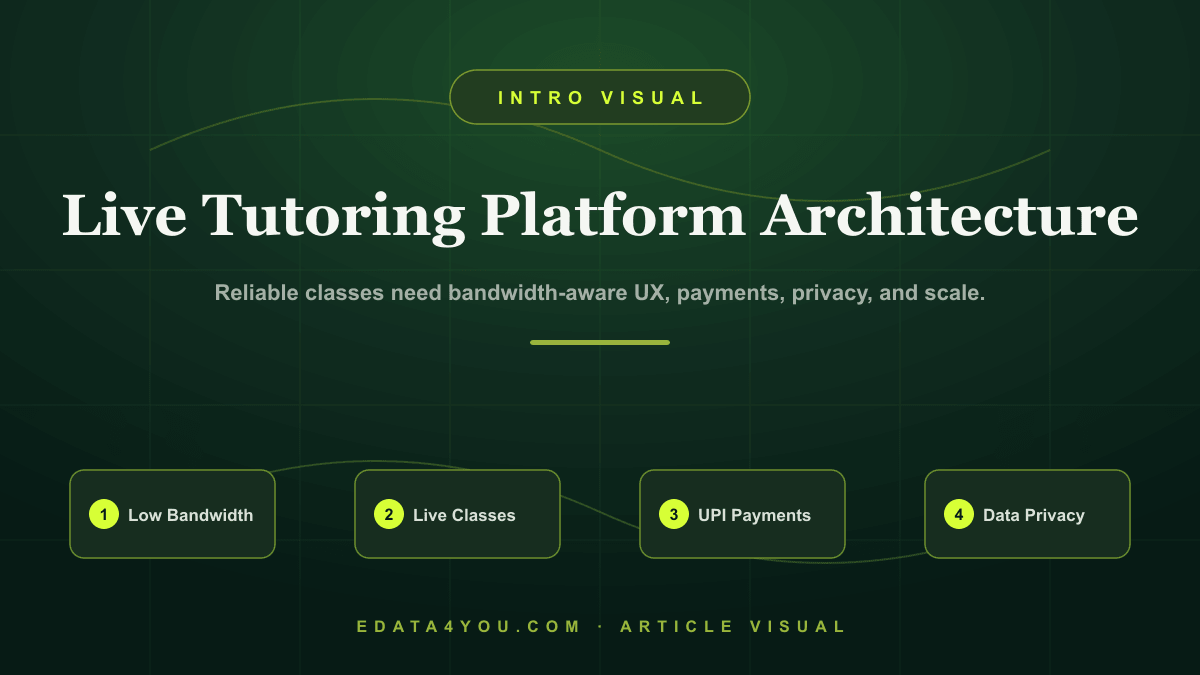
A successful live tutoring platform in India has to work across peak traffic, inconsistent networks, low-cost devices, local languages, and high-trust payment flows.
Need help applying this? Explore our Web Design & Development.
Why Web Development is the Backbone of Live Tutoring Success

In the EdTech world, technology isn’t just an enabler—it’s the entire foundation upon which learning experiences are built. While competitors focus on celebrity endorsements and aggressive marketing, the platforms that truly succeed understand a fundamental truth: web development decisions matter more than marketing budgets or funding announcements.
Consider this: a student struggling with organic chemistry at 11 PM doesn’t care about your startup’s latest funding round. They need seamless video streaming, responsive whiteboards, and instant doubt resolution. A teacher in rural Karnataka doesn’t need flashy advertisements—they need reliable technology that works on their basic smartphone with inconsistent 3G connectivity.
Every millisecond of latency, every dropped connection, every payment failure directly impacts learning outcomes. When technology fails, students lose confidence, teachers abandon platforms, and educational goals remain unfulfilled. The most beautifully designed curriculum becomes worthless if the underlying technology can’t deliver it consistently to India’s diverse digital landscape.
This is why smart EdTech founders obsess over technical architecture before they hire their first marketing manager. They understand that in live tutoring, user experience is learning experience—and both are entirely dependent on robust web development practices.
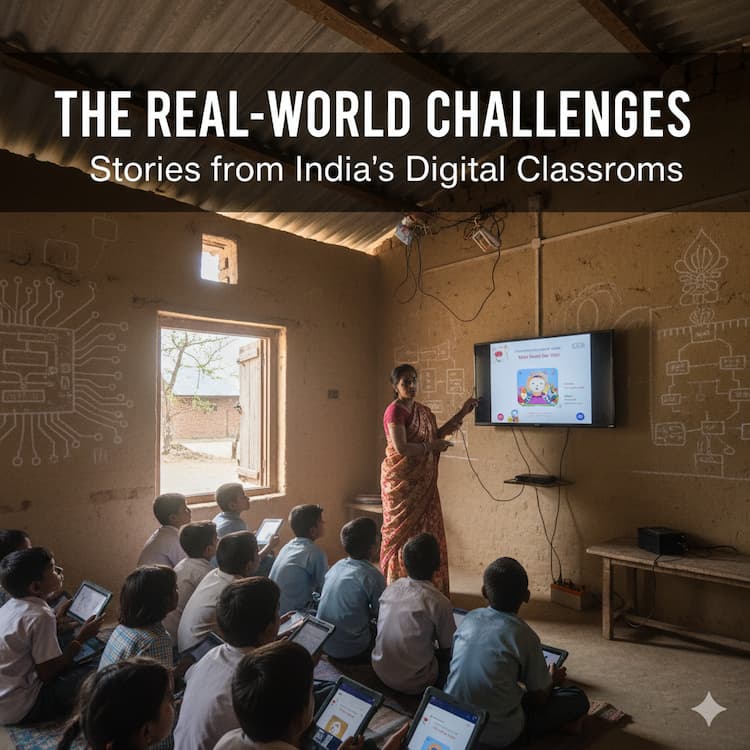
The Real-World Challenges: Stories from India’s Digital Classrooms
1. The 7 PM Rush Hour: When Scalability Dreams Meet Reality
Every evening at 7 PM, something magical happens across Indian households—millions of students simultaneously open their devices for after-dinner study sessions. For live tutoring platforms, this creates a perfect storm of technical challenges.
Imagine Unacademy’s servers when Kailash Sharma, their star physics teacher, starts a free JEE preparation session. Within minutes, 50,000 students flood the platform. The database struggles to authenticate users, video servers buckle under streaming pressure, and chat systems crash from thousands of simultaneous messages. Students see infinite loading screens instead of Newton’s laws, leading to frustrated parents questioning their EdTech investment choices.
This isn’t just about buying more servers—it’s about architecting systems that can elastically scale from 1,000 to 100,000 concurrent users within minutes, then gracefully scale back down. The challenge intensifies during exam seasons when traffic patterns become wildly unpredictable, and a single technical failure can impact thousands of crucial study hours.
2. The Bandwidth Reality Check: When Dreams Meet 2G Networks
Meera Patel, a bright Class 12 student from Bhuj, Gujarat, dreams of cracking NEET. She’s enrolled in BYJU’S premium course, but her village receives inconsistent 2G coverage that struggles to load basic websites, let alone HD video streams. When she does connect, the 720p chemistry lectures consume her entire monthly data allowance within days.
Her story isn’t unique—over 60% of Indian students access online education through mobile networks with speeds below 10 Mbps. While urban developers test their platforms on fiber connections, rural students face the harsh reality of buffering videos, incomplete downloads, and data overage charges that strain family budgets.
The technical challenge extends beyond compression algorithms. Platforms must intelligently adapt content delivery based on real-time network conditions, provide meaningful educational experiences even in audio-only modes, and cache critical content locally for offline access. It’s not enough to detect poor connectivity—platforms must gracefully degrade while maintaining educational value.
3. Interactive Features Under Pressure: When Whiteboards Become Bottlenecks
During a live geometry class, teacher Suresh Menon draws a complex triangle on his digital whiteboard while explaining angle bisector theorems. Simultaneously, 800 students watch his annotations, 200 type questions in chat, and 50 participate in a real-time poll about triangle properties. Behind the scenes, the platform must synchronize these interactions across multiple servers while maintaining millisecond precision.
The technical complexity explodes when students use different devices with varying processing power. Ramesh follows the lesson on his Samsung Galaxy A12, while Kavya watches on her family’s shared iPad. The whiteboard annotations must render identically across both devices, despite vastly different screen resolutions and processing capabilities.
Real-time interactivity becomes even more challenging with mathematical content. LaTeX equations, geometric diagrams, and chemical structures require precise rendering that doesn’t break when network packets arrive out of order. A single synchronization failure can make a calculus derivative appear incorrectly, leading to confused students and frustrated teachers.
4. Payment Chaos: When UPI Fails During Course Enrollment
It’s the last day of BYJU’S discount offer, and Rohit Sharma’s father decides to enroll his son in the annual program. The family has saved ₹25,000 for this investment in their child’s future. But as Mr. Sharma attempts payment through UPI, the transaction fails with a cryptic error message. Frustrated and worried about missing the discount, he tries again—only to discover the amount was deducted twice, but no course access was granted.
This scenario highlights India’s unique payment challenges. While UPI has revolutionized digital payments, EdTech platforms must navigate complex scenarios: failed transactions that still deduct money, network timeouts during payment processing, and compliance with RBI’s auto-debit mandate regulations. Family plans, sibling discounts, and EMI options add layers of complexity that can break poorly designed payment systems.
The technical challenge isn’t just integration—it’s building resilient systems that handle edge cases gracefully while maintaining regulatory compliance. When payments fail, platforms need instant refund mechanisms, clear communication channels, and alternative payment methods that work across India’s diverse banking ecosystem.
5. Privacy Under the Microscope: Student Data in the DPDP Era
When 14-year-old Ananya Singh joins Vedantu’s live classes, she unknowingly generates a treasure trove of data: learning patterns, performance analytics, interaction preferences, and behavioral insights. This information helps personalize her education but also creates massive privacy responsibilities under India’s new Digital Personal Data Protection (DPDP) Act 2023.
The platform must secure not just traditional data like names and addresses, but also learning analytics, recorded sessions, submitted assignments, and peer interaction logs. Every feature—from doubt submission to performance tracking—requires explicit consent mechanisms that a 14-year-old can understand and legally provide.
The technical complexity multiplies when considering data localization requirements, right-to-deletion requests, and consent withdrawal mechanisms. If Ananya’s parents decide to switch platforms, Vedantu must provide all her data in a portable format while completely purging it from their systems. Meanwhile, the platform must continue delivering personalized learning experiences without compromising privacy safeguards.
6. Device Fragmentation: The Multi-Screen Challenge
Professor Maya Krishnan teaches advanced calculus from her MacBook Pro’s 27-inch monitor, complete with high-resolution mathematical notation and detailed graphs. Her students, however, experience the same lesson through a kaleidoscope of devices: Rohit watches on his Xiaomi Redmi Note 8 (6-inch screen), Priya follows along on her family’s 10-year-old desktop with Internet Explorer, and Arjun tunes in through his smart TV during family study time.
Each device presents unique challenges: touch interfaces versus mouse navigation, portrait versus landscape orientations, varying processing power, and different browser capabilities. The calculus equations that appear crisp on Professor Krishnan’s monitor become illegible when compressed onto Rohit’s smartphone screen. Interactive elements designed for desktop mice become unusable on Priya’s touch interface.
The technical solution isn’t just responsive design—it’s adaptive functionality that maintains educational effectiveness across every device configuration. Mathematical content must remain comprehensible whether viewed on a 4-inch smartphone or 55-inch television, while interactive features must work equally well with finger taps and mouse clicks.
7. The Language Labyrinth: Beyond English Education
Kavitha Reddy, a chemistry teacher from Hyderabad, prefers explaining complex organic reactions in Telugu—her native language allows nuanced explanations that English translations often miss. Her students, spread across Andhra Pradesh and Telangana, also think and learn better in their mother tongue. However, the EdTech platform she uses treats multilingual support as an afterthought, resulting in awkward interfaces, broken mathematical notation, and cultural misalignments.
India’s linguistic diversity creates unique technical challenges beyond simple translation. Telugu script requires different rendering engines than Devanagari, mathematical notation must adapt to right-to-left reading patterns in Urdu, and voice recognition systems must understand regional accents and code-switching between languages.
The complexity extends to content localization—a physics concept explained through cricket analogies resonates with Indian students but might confuse international learners. Cultural context, local examples, and regional examination patterns must be seamlessly integrated into multilingual interfaces without compromising functionality.
How Smart EdTechs Are Solving These Challenges
Vedantu’s Bandwidth Intelligence: Adapting to India’s Network Reality
When Vedantu’s engineering team analyzed their traffic patterns, they discovered a stark reality: 40% of their students accessed classes through networks slower than 1 Mbps. Instead of ignoring this segment, they built adaptive streaming intelligence that revolutionized low-bandwidth learning experiences.
Their solution automatically detects network conditions and switches between multiple content streams: HD video for fiber connections, optimized SD for 3G networks, and audio-plus-slides mode for 2G areas. During network fluctuations, the platform gracefully transitions between modes without interrupting the learning flow. Students see a small notification—”Optimizing for your connection”—while the technology seamlessly maintains educational continuity.
Vedantu also implemented predictive caching that downloads essential content during stable connectivity periods, allowing students to continue learning even during temporary network failures. Their mobile app pre-loads upcoming lesson materials when connected to WiFi, ensuring rural students can access core content regardless of cellular network reliability.
Unacademy’s Gamified Simplicity: Making Technology Invisible
Unacademy faced a unique challenge: their target audience included both tech-savvy urban students and teachers from tier-3 cities with limited digital literacy. Their solution transformed complex platform navigation into an intuitive, game-like experience that appeals to diverse user groups.
New teachers complete interactive onboarding quests that teach platform features through hands-on practice rather than overwhelming documentation. They start live teaching within 15 minutes of registration, with contextual tooltips guiding them through advanced features gradually. Students earn achievement badges for consistent attendance, active participation, and helping peers—gamification elements that encourage engagement while familiarizing users with platform capabilities.
The genius lies in progressive disclosure: basic users see simplified interfaces with essential features, while power users can unlock advanced tools through usage patterns. A rural teacher initially sees only core teaching tools, but as they become comfortable, features like breakout rooms, advanced analytics, and collaborative whiteboards become available naturally.
BYJU’S Universal Access: One Platform, Every Device
BYJU’S engineering philosophy centers on universal access—ensuring identical educational experiences whether students use ₹8,000 smartphones or ₹80,000 laptops. Their Progressive Web App (PWA) architecture delivers native app performance through web browsers, eliminating app store dependencies and storage constraints on budget devices.
Their responsive design system adapts content presentation based on screen real estate and processing power. Mathematical equations automatically resize and reformat for optimal readability, while interactive animations scale performance based on device capabilities. A complex chemistry simulation runs smoothly on high-end devices while gracefully simplifying to essential elements on budget smartphones without losing educational value.
BYJU’S also pioneered offline-first architecture for Indian markets. Students can download entire course modules during WiFi availability, then access content seamlessly during commutes or in areas with poor connectivity. The platform intelligently syncs progress data when connectivity resumes, ensuring consistent learning tracking across online and offline sessions.
Razorpay’s EdTech Payment Suite: Solving India’s Transaction Complexity
Leading EdTech platforms have partnered with Razorpay to navigate India’s complex payment landscape through specialized EdTech solutions. Razorpay’s education-focused APIs handle unique scenarios like family plans, sibling discounts, installment payments, and corporate bulk enrollments that generic payment systems struggle with.
Their intelligent routing system automatically selects optimal payment methods based on user preferences, success rates, and transaction amounts. For high-value course purchases, the system might route through UPI for lower costs, while smaller transactions use faster card processing. Failed transaction recovery mechanisms automatically retry payments through alternative channels while keeping users informed throughout the process.
Razorpay also provides built-in compliance tools for RBI regulations, automated GST calculations, and instant refund processing. When payment issues arise, their APIs communicate with EdTech platforms to provide real-time updates, transparent error messages, and alternative payment options without losing customer trust or enrollment momentum.
Turn these recommendations into a working process with Web Design & Development.
Developer’s Playbook: Essential Implementation Checklist
| Platform layer | What to implement |
|---|---|
| Video and live class delivery | Adaptive bitrate streaming, CDN edges, failover, reconnect logic, and audio-first fallback |
| Real-time classroom tools | Low-latency whiteboard sync, chat moderation, polls, equations, and device-safe rendering |
| Mobile performance | PWA support, offline caching, lazy loading, memory optimization, and touch-first interactions |
| Payments | UPI, cards, wallets, EMI, failed-payment recovery, refunds, invoices, and GST workflows |
| Security and privacy | DPDP-ready consent, encryption, access controls, data deletion, breach response, and parent visibility |
| Localization | Indian language scripts, regional examples, accessible fonts, and culturally relevant UX |
✅ Cloud Infrastructure and Scalability
Implement elastic cloud architecture using AWS Auto Scaling Groups or Google Cloud Platform’s managed instance groups. Configure automatic scaling triggers based on concurrent user thresholds, CPU utilization, and database connection pools.
Deploy multi-region CDNs with Indian edge servers in Mumbai, Delhi, Bangalore, and Chennai. Partner with local providers like Tata Communications for optimal last-mile delivery to tier-2 and tier-3 cities.
Use microservices architecture to isolate video streaming, user authentication, payment processing, and content delivery. This allows independent scaling of system components based on real-time demand patterns.
✅ Bandwidth Optimization and Connectivity
Integrate adaptive bitrate streaming using technologies like HLS for iOS and DASH for Android. Implement automatic quality switching based on network conditions without user intervention.
Build offline-capable PWAs that cache essential content during stable connectivity periods. Use service workers for intelligent background synchronization and graceful degradation during network failures.
Compress and optimize content using modern codecs like H.265 and WebP images. Implement lazy loading for non-critical resources and progressive enhancement for core features.
✅ India-Ready Payment Integration
Choose compliance-ready gateways like Razorpay, Cashfree, or Paytm that understand Indian regulations. Implement multiple gateway support for redundancy and cost optimization.
Support diverse payment methods including UPI, digital wallets, EMI options, and bank transfers. Build intelligent payment routing based on user preferences and transaction success rates.
Implement robust error handling with clear user communication, automatic retry mechanisms, and instant refund processing for failed transactions.
✅ Security and DPDP Compliance
Encrypt all data transmission using TLS 1.3 and implement AES-256 encryption for data storage. Use secure key management systems and regular security audits.
Build consent management systems that comply with DPDP Act requirements. Implement transparent privacy controls, data portability features, and user-friendly consent withdrawal mechanisms.
Establish incident response procedures with automated breach detection, notification systems, and legal compliance workflows for data protection violations.
✅ Cross-Device Compatibility
Design mobile-first experiences optimized for touch interfaces and small screens. Implement responsive layouts that adapt to various screen sizes and orientations.
Test across device spectrum including budget Android phones, older iPhones, desktop browsers, and smart TVs. Use progressive enhancement to ensure core functionality works on all platforms.
Optimize performance for low-RAM devices through efficient memory management, lazy loading, and background processing optimization.
✅ Multilingual and Cultural Adaptation
Implement Unicode standards for proper rendering of Indian scripts like Devanagari, Tamil, and Arabic. Use web fonts optimized for regional languages and mathematical notation.
Integrate AI-powered translation services for real-time content localization. Build custom language models trained on educational content for better accuracy.
Design culturally appropriate interfaces that respect local design patterns, reading directions, and user behavior expectations across different regions.
Future Outlook: What’s Next for Indian Live Tutoring Platforms?
NEP 2020: The Personalization Revolution
The National Education Policy 2020’s emphasis on competency-based learning and personalized education is driving the next wave of EdTech innovation. Platforms are moving beyond one-size-fits-all approaches toward AI-driven personalization that adapts to individual learning styles, pace, and preferences.
Advanced analytics now track micro-learning patterns—how long students pause during complex explanations, which examples resonate most effectively, and optimal spacing between concept introduction and assessment. This granular data enables platforms to customize content delivery, adjust difficulty progression, and predict learning outcomes with increasing accuracy.
The technical challenge lies in processing massive datasets while maintaining real-time responsiveness. Machine learning models must operate at the edge, providing instant personalization without compromising user privacy or system performance.
Digital India: Infrastructure Transformation
The government’s Digital India initiative is rapidly transforming the technological landscape that EdTech platforms operate within. The BharatNet project aims to connect 600,000 villages with high-speed broadband, while 5G rollout promises to eliminate many current bandwidth constraints.
This infrastructure evolution enables new possibilities: augmented reality chemistry labs accessible from rural classrooms, virtual reality historical experiences, and real-time collaborative projects between students across different states. Platforms that architect for these capabilities today will be positioned to leverage enhanced infrastructure tomorrow.
However, the transition period requires platforms to support both current limitations and future capabilities simultaneously. Adaptive systems must gracefully utilize enhanced connectivity when available while maintaining compatibility with existing network constraints.
AI Integration: The Intelligent Classroom
Artificial intelligence is transforming from a buzzword to an essential platform component. Natural language processing enables instant doubt resolution, computer vision analyzes student engagement patterns, and predictive analytics optimize learning pathways for better outcomes.
Voice-activated learning assistants help students navigate complex topics in their preferred languages, while automated content generation creates personalized practice problems based on individual weakness areas. AI-powered proctoring systems ensure assessment integrity without compromising accessibility.
The technical challenge involves balancing AI capabilities with computational efficiency. Edge computing brings intelligence closer to users, reducing latency while maintaining privacy. Platforms must architect AI systems that enhance rather than complicate the learning experience.
Immersive Learning Technologies
Virtual and augmented reality technologies are moving from experimental features to mainstream educational tools. Chemistry students can manipulate molecular structures in 3D space, history lessons can transport students to ancient civilizations, and mathematics concepts can be visualized through interactive spatial representations.
However, implementing immersive technologies for India’s diverse device ecosystem requires careful consideration. WebXR standards enable VR experiences through web browsers without specialized hardware, while AR features can work through smartphone cameras that most students already possess.
The key lies in progressive enhancement—providing enhanced experiences for capable devices while maintaining core educational value for basic configurations. A chemistry lesson should be engaging whether experienced through VR goggles or traditional video streaming.
Building Tomorrow’s Classroom Today
The live tutoring platforms that will lead India’s EdTech revolution aren’t necessarily those with the largest marketing budgets or celebrity endorsements. They’re the ones solving fundamental technical challenges today while architecting for tomorrow’s possibilities.
Success in Indian EdTech requires deep understanding of local constraints coupled with global technical excellence. Platforms must simultaneously handle a student in Mumbai accessing lessons through 100 Mbps fiber and another in rural Rajasthan learning through intermittent 2G connectivity. They must protect privacy while personalizing experiences, simplify interfaces while maintaining powerful functionality.
The technical decisions made today—from database architecture to content delivery strategies—will determine which platforms can scale to serve India’s 350 million students effectively. Those who invest in robust foundations, inclusive design, and adaptive technologies will find themselves uniquely positioned to leverage emerging opportunities in AI, immersive technologies, and enhanced connectivity.
If you’re building a tutoring platform in India, don’t just code for today’s classroom—architect for tomorrow’s educational revolution. The students logging in at 7 PM tonight deserve technology that doesn’t just work, but works brilliantly across India’s incredible diversity. The future of education depends on making that vision a technical reality.
Let's build something great together
A dedicated team of ecommerce, design, and data specialists - ready to scale your business across every marketplace.
Recent Posts
Latest on Social
Grow your sales on Amazon, Walmart & more
Our marketplace specialists handle listings, SEO, catalog & ads - end to end.
Talk to an Expert
Amit Sharma
Founder & IT Head | Project Management & IT Strategy Expert


Leave a Comment