

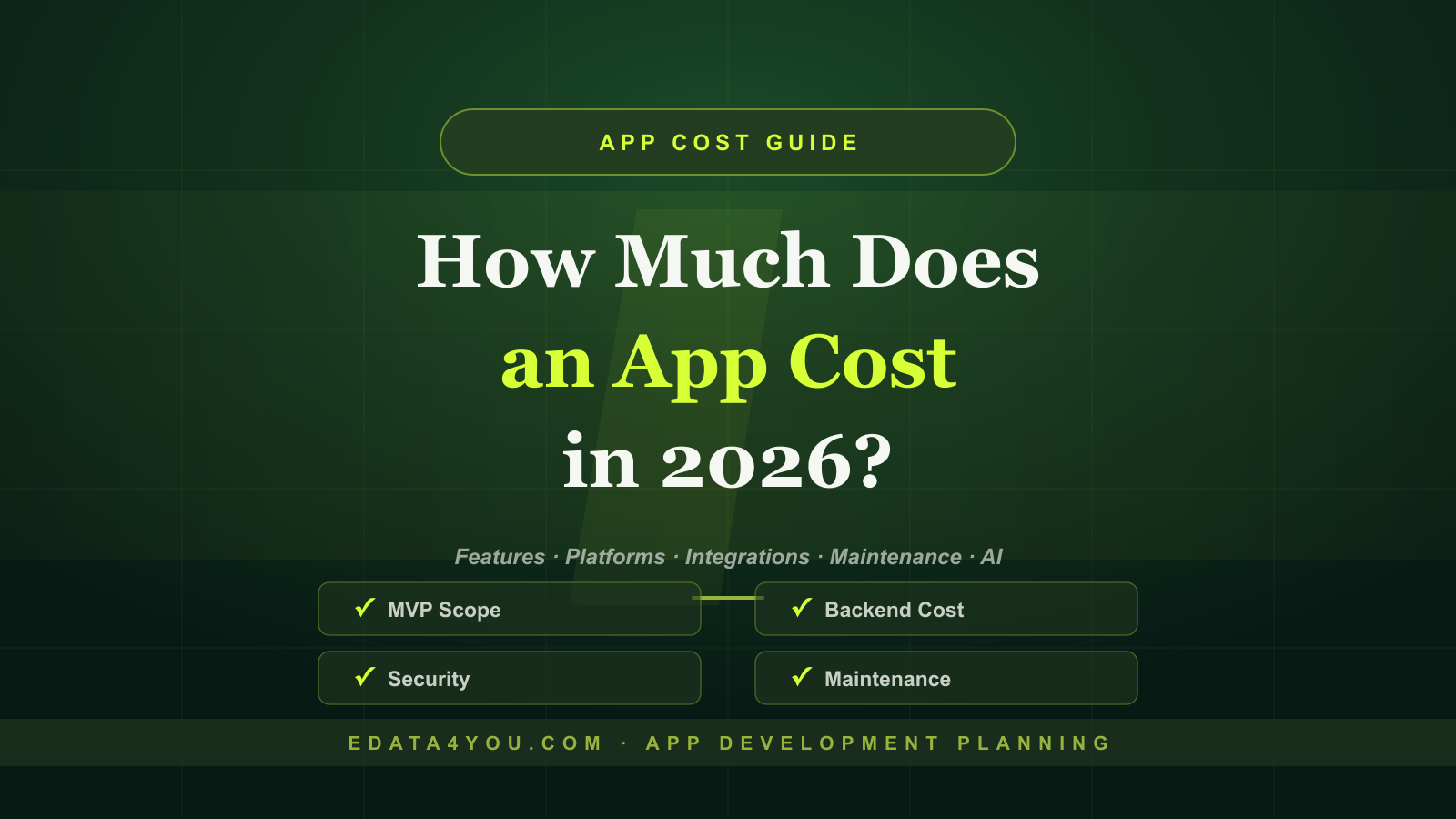
Quick answer
What you need to know
App development costs in 2026 range from a few thousand dollars for simple tools to several hundred thousand for enterprise platforms. Here is how to estimate what you actually need.
How Much Does It Cost to Build an App in 2026?
App Cost by Complexity Level
The Main Factors That Determine App Cost
Premium reader tools
Turn insight into action
The brief, before you dive in
A practical snapshot of what this guide will help you understand and apply.
Key takeaways
- How Much Does It Cost to Build an App in 2026?: App development costs in 2026 range from $10,000 to $500,000 or more, depending on the complexity of features, the number of platforms, the team's loc…
- App Cost by Complexity Level: The simplest way to estimate development cost is by complexity tier.
- The Main Factors That Determine App Cost: Platform Choice: iOS, Android, or Both Building for both iOS and Android simultaneously roughly doubles the development cost compared to building for …
- How Location Affects App Development Cost: The location of your development team is one of the biggest cost variables.
Need help applying this? Explore our Web Design & Development.
How Much Does It Cost to Build an App in 2026?
App development costs in 2026 range from $10,000 to $500,000 or more, depending on the complexity of features, the number of platforms, the team's location, and the quality of design and backend infrastructure. A simple utility app built by an offshore team costs far less than an enterprise platform with custom integrations and AI features.
Most businesses underestimate app costs because they focus on the feature list without accounting for design, backend infrastructure, testing, app store setup, and ongoing maintenance. This guide breaks down the real cost drivers so you can build a budget that reflects what you are actually building.
App Cost by Complexity Level
The simplest way to estimate development cost is by complexity tier. These ranges reflect typical market rates in 2026 across a mix of onshore and offshore development teams.
| App Type | Typical Cost Range | Examples |
|---|---|---|
| Simple app (1-2 screens, basic function) | $10,000 to $30,000 | Calculator, timer, single-feature utility |
| Standard app (5-10 screens, user accounts) | $30,000 to $80,000 | Service booking, event listing, basic ecommerce |
| Mid-complexity app (multiple flows, integrations) | $80,000 to $180,000 | Marketplace, on-demand service, fitness tracker |
| Complex app (custom backend, AI, many integrations) | $180,000 to $400,000+ | Fintech, healthcare, enterprise operations platform |
These are starting estimates. Apps that require real-time functionality, payment processing, third-party API integrations, or AI features will sit at the higher end of each range.
The Main Factors That Determine App Cost
Platform Choice: iOS, Android, or Both
Building for both iOS and Android simultaneously roughly doubles the development cost compared to building for a single platform, unless you use a cross-platform framework such as React Native or Flutter.
Cross-platform development typically costs 30 to 40 percent less than building two separate native apps, but native apps perform better for hardware-intensive applications such as augmented reality, advanced camera features, or high-frequency data processing.
If you are launching for the first time and need to validate the product, consider starting with one platform. Most B2B apps find more usage on iOS; consumer apps depend heavily on your audience's device preferences.
UX and UI Design
Design is not a cosmetic expense. A poorly designed app has high abandonment rates, poor review scores, and high support costs. Design includes user research, wireframing, visual design, prototyping, and usability testing.
Professional UX/UI design for a mid-complexity app typically adds $10,000 to $40,000 to the project budget. Cutting this budget is one of the most common reasons apps fail after launch.
Backend Infrastructure
Every app that stores user data, syncs across devices, handles payments, or connects to third-party services needs a backend. The backend includes a server, database, API layer, authentication system, and security infrastructure.
Backend development typically accounts for 30 to 50 percent of total app development cost. Apps that need real-time features such as live chat, location tracking, or inventory sync require more complex backend architecture and cost more to build and maintain.
Third-Party Integrations
Payment processing, mapping, push notifications, analytics, CRM sync, and social login all require third-party integrations. Each integration adds development time, testing time, and ongoing maintenance. Budget $2,000 to $10,000 per significant integration depending on complexity.
AI and Machine Learning Features
AI features such as personalized recommendations, predictive search, smart notifications, chatbots, and image recognition add significant cost because they require data pipelines, model training or API integration, and ongoing monitoring.
Using third-party AI APIs such as OpenAI, Google Vertex, or AWS AI services is cheaper than building custom models. Budget $5,000 to $30,000 for basic AI feature integration, and significantly more for custom model development.
Testing and Quality Assurance
Thorough QA typically costs 15 to 25 percent of total development cost. Apps that skip proper testing launch with bugs that damage reviews and require expensive hotfixes. Testing covers functional testing, performance testing, security testing, and device compatibility testing across multiple screen sizes and OS versions.
Turn these recommendations into a working process with Web Design & Development.
How Location Affects App Development Cost
The location of your development team is one of the biggest cost variables. These are approximate hourly rate ranges in 2026:
| Region | Average Developer Hourly Rate |
|---|---|
| United States / Canada | $150 to $250 |
| Western Europe | $100 to $180 |
| Eastern Europe | $50 to $100 |
| India | $25 to $70 |
| Southeast Asia | $30 to $80 |
| Latin America | $40 to $90 |
Offshore development in India offers significant cost reduction without sacrificing quality when you work with an experienced team and maintain clear communication throughout the project. Many successful apps used by global brands are built by Indian development teams.
What Are the Ongoing Costs After Launch?
App development does not end at launch. Ongoing costs include:
- App store fees: Apple charges $99 per year for the developer program. Google charges a one-time $25 fee.
- Server and infrastructure: Cloud hosting typically costs $50 to $2,000 per month depending on user volume and data storage.
- Maintenance and updates: OS updates, security patches, and feature additions require ongoing development time. Budget 15 to 20 percent of original development cost per year for maintenance.
- Customer support: As your user base grows, support volume grows with it.
- Marketing: App discovery is competitive. Budget for app store optimization, paid acquisition, and content marketing from day one.
Many businesses launch an app and then underfund the maintenance and growth phase. Ongoing costs over two years frequently exceed the original development cost.
How to Control App Development Costs
Start with an MVP. An MVP (minimum viable product) includes only the core features needed to validate the concept. Build the full feature list after you have user data proving what people actually use.
Define scope in writing. Vague requirements are the most common cause of budget overruns. Every feature should be documented with specific behavior before development starts. Changes to scope after development begins are expensive.
Use cross-platform frameworks for standard apps. React Native and Flutter handle most standard app use cases efficiently and cost significantly less than two separate native builds.
Hire an experienced team, not the cheapest one. Junior developers who quote low rates often require rework that exceeds the cost difference. Review portfolios, check references, and evaluate communication quality before hiring.
Plan the backend from the start. Retrofitting a backend onto an app that was not designed for one is expensive. Design the data model and API structure before writing front-end code.
Should You Outsource App Development?
Outsourcing app development to an experienced team is a practical choice for most businesses that do not have in-house mobile development capability. The key is choosing a team with a strong portfolio in your category, a clear development process, and references you can actually contact.
Ask any development team you evaluate for examples of apps they have built that are live in the app store, for the development methodology they use, and for how they handle scope changes and communication during the project.
eData4You works with ecommerce brands and businesses on product and catalog operations that support app-powered retail experiences, including product data management, marketplace integration, and back-office support. Contact us to discuss your operational requirements.
Let's build something great together
A dedicated team of ecommerce, design, and data specialists - ready to scale your business across every marketplace.
Recent Posts
Latest on Social
Grow your sales on Amazon, Walmart & more
Our marketplace specialists handle listings, SEO, catalog & ads - end to end.
Talk to an Expert
Amit Sharma
Founder & IT Head | Project Management & IT Strategy Expert
Leave a Comment