

Quick answer
What you need to know
Learn why catalog content production is essential for ecommerce websites, including product descriptions, images, attributes, SEO, marketplace readiness, conversion quality, and AI-ready catalog data.
What Is Catalog Content Production?
Why Catalog Content Is a Revenue Asset
The Core Elements of High-Quality Catalog Content
Premium reader tools
Turn insight into action
The brief, before you dive in
A practical snapshot of what this guide will help you understand and apply.
Key takeaways
- What Is Catalog Content Production?: Catalog content production is the process of creating, organizing, enriching, validating, and maintaining product information for ecommerce selling.
- Why Catalog Content Is a Revenue Asset: Catalog content directly affects sales.
- The Core Elements of High-Quality Catalog Content: Ecommerce catalog content should be built from both structured data and persuasive copy.
- Catalog Content Production and Ecommerce SEO: Catalog content production is one of the strongest foundations for ecommerce SEO.
Catalog content production is the operational backbone of ecommerce. A website can have strong design, paid traffic, discounts, and a polished checkout, but customers still will not buy confidently if the product content is incomplete, inconsistent, or difficult to trust.
Every product page has to answer practical buying questions: What is this product? Who is it for? What size is it? What material is it made from? Will it fit my use case? What comes in the box? How does it compare with similar options? Can I trust the images, specifications, and delivery information?
In 2026, catalog content also does more than support human shoppers. It feeds search engines, marketplace algorithms, AI shopping assistants, recommendation engines, customer support bots, product feeds, ads, analytics dashboards, and internal operations. Weak catalog content creates problems across the entire ecommerce system.
This guide explains why catalog content production is a must for ecommerce business websites, what it includes, how AI changes the workflow, and how to build a scalable catalog content process.
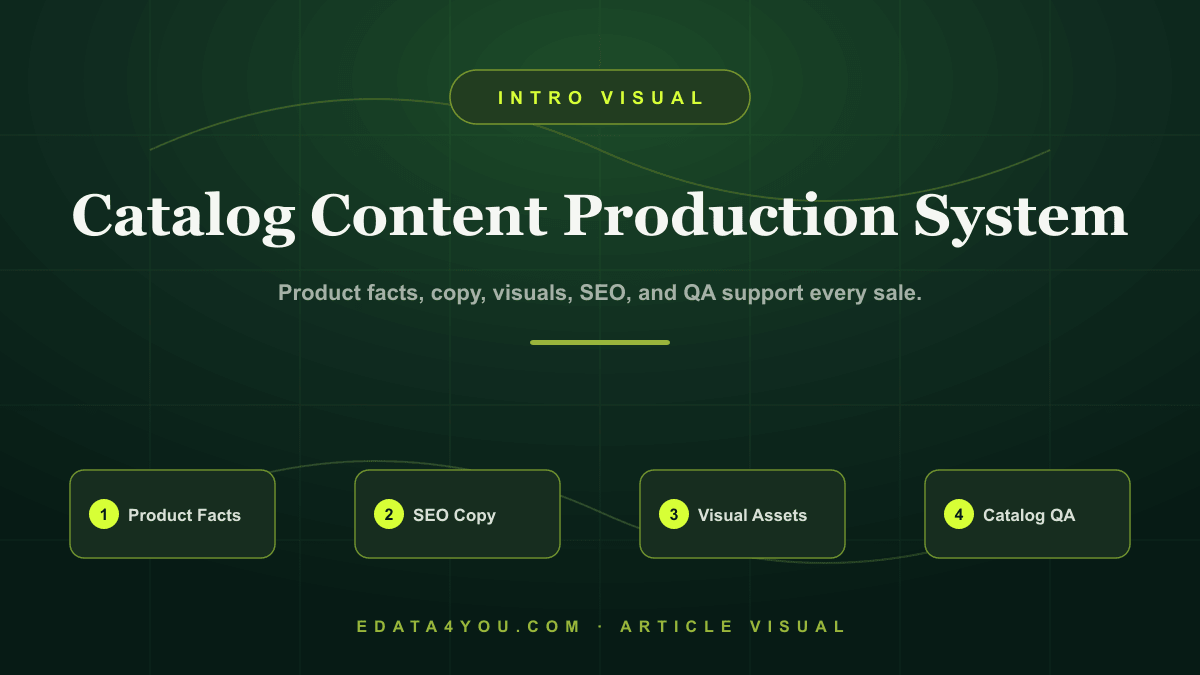
Great catalog content connects product facts, search visibility, customer confidence, marketplace compliance, and AI-ready data.
Need help applying this? Explore our Product Data Management.
What Is Catalog Content Production?
Catalog content production is the process of creating, organizing, enriching, validating, and maintaining product information for ecommerce selling.
It includes everything a customer and commerce system needs to understand a product:
- Product titles
- Short descriptions
- Long descriptions
- Bullet points and key features
- Product specifications
- Product attributes
- Category mapping
- Brand and manufacturer details
- SKU and variant data
- Size, color, pack, bundle, and compatibility information
- Product images, videos, alt text, and media order
- SEO metadata
- Product feed fields
- Marketplace upload templates
- Pricing, availability, and inventory-related fields
For a small store with a few products, this can feel manageable. For an ecommerce business with hundreds or thousands of SKUs, catalog content production becomes a serious operating function.
Why Catalog Content Is a Revenue Asset
Catalog content directly affects sales. It shapes how customers discover products, how they compare choices, how confident they feel, and whether they complete the purchase.
Poor product content creates friction. Customers leave when they cannot find the right size, do not understand the material, cannot confirm compatibility, or see vague product images. They may also buy the wrong item, which increases returns and support tickets.
Strong catalog content improves:
- Organic search visibility
- Marketplace ranking signals
- Internal site search
- Product filters and navigation
- Paid shopping feed quality
- Product page conversion
- Customer support accuracy
- Return reduction
- Cross-sell and upsell opportunities
- AI-generated recommendations and summaries
The product page is not just a page. It is the point where content, data, trust, and revenue meet.
The Core Elements of High-Quality Catalog Content
Ecommerce catalog content should be built from both structured data and persuasive copy. One without the other is incomplete.
1. Product Titles
A strong title should be clear to customers and useful for search. It should include the most important product identifiers without becoming keyword spam.
Useful title structure:
Brand + Product Type + Key Attribute + Material/Use Case + Size/Color/Pack
Examples:
| Weak Title | Stronger Ecommerce Title |
|---|---|
| Storage Box | Sterilite Clear Plastic Storage Box with Lid, 18-Gallon, 6-Pack |
| Black Shoes | Nike Men's Running Shoes, Lightweight Mesh, Black, Size 10 |
| Phone Case | Spigen iPhone 16 Pro Case, Shockproof TPU Cover, Matte Black |
The goal is to help shoppers understand the product quickly while giving search systems enough context.
2. Product Descriptions
Descriptions should not simply repeat the title. They should answer customer questions and explain why the product is useful.
A good product description usually covers:
- Who the product is for
- Main use case
- Key benefits
- Important features
- Materials or ingredients
- Dimensions or technical specifications
- Compatibility
- Care instructions
- What is included
- Warranty or support notes where applicable
Descriptions should be unique wherever possible. Copying manufacturer content across hundreds of product pages weakens SEO and creates a thin, repetitive catalog.
3. Bullet Points and Key Features
Bullets help shoppers scan quickly, especially on mobile. Each bullet should communicate one useful point rather than stuffing keywords.
Better bullets usually follow this structure:
Feature + Benefit + Detail
Example:
- Leak-resistant lid: Helps prevent spills during travel, office use, or gym workouts.
- BPA-free material: Designed for everyday use with cold beverages and easy cleaning.
- Wide-mouth opening: Makes it easier to add ice, clean the bottle, and refill quickly.
4. Product Attributes
Attributes are structured fields such as color, material, size, fit, capacity, gender, age group, compatibility, finish, pack count, product type, and dimensions.
Attributes power:
- Site filters
- Category pages
- Search relevance
- Product comparison
- Marketplace templates
- Product feeds
- AI product matching
- Recommendation systems
If attributes are missing, customers may never find the product even when the description is well written.
5. Product Images and Visual Content
Images build trust faster than text. A complete visual stack usually includes:
- Main product image
- Lifestyle image
- Feature infographic
- Scale or dimension image
- Detail close-up
- Packaging image if relevant
- Variant images
- Product video where useful
For ecommerce websites, image file names, alt text, image order, and product matching also matter. A great description cannot rescue a product page with confusing or mismatched images.
Catalog Content Production and Ecommerce SEO
Catalog content production is one of the strongest foundations for ecommerce SEO. Search engines need clear product information, category relevance, structured content, and unique copy.
Important SEO areas include:
- Product title optimization
- Category and subcategory alignment
- Unique descriptions
- FAQ content where relevant
- Image alt text
- Internal linking
- Schema-friendly product details
- Clean URL and metadata structure
- Consistent attributes
- Product feed accuracy
The mistake many stores make is treating SEO as something added after catalog work is complete. In reality, ecommerce SEO should be built into the catalog production process from the start.
Why Catalog Content Matters for Marketplaces
Many ecommerce businesses sell across their own website and marketplaces such as Amazon, Walmart, eBay, Etsy, Shopify channels, Flipkart, or quick commerce platforms.
Each channel has different rules for:
- Product titles
- Required attributes
- Image standards
- Category taxonomy
- Variation relationships
- Character limits
- Restricted claims
- Backend search fields
- Upload templates
Catalog content production should create a strong master product record, then adapt that record for each channel. This prevents the team from rewriting product content from scratch every time a new marketplace is added.
The Role of AI in Catalog Content Production
AI can make catalog content production faster, but it cannot replace accurate source data. If the input is wrong, AI will confidently produce wrong content.
AI can help with:
- First-draft product descriptions
- Title variations
- Bullet point drafts
- Attribute suggestions
- Category recommendations
- Product summary generation
- Duplicate content detection
- Translation support
- Support article drafts
- SEO metadata drafts
AI should not be allowed to invent facts. Product dimensions, materials, compatibility, certifications, ingredients, safety claims, warranty details, and legal claims must come from verified product data.
The best workflow is human plus AI:
- Build a clean product data source.
- Use AI to accelerate drafts and variations.
- Review for factual accuracy.
- Apply brand and marketplace rules.
- Run QA before publishing.
Catalog Content Production Workflow
A scalable catalog content workflow prevents confusion between writers, data entry teams, image teams, marketplace managers, and developers.
Recommended workflow:
| Step | What Happens |
|---|---|
| 1. Data Collection | Gather supplier sheets, product specs, images, pricing, inventory, and existing content |
| 2. Data Cleaning | Standardize SKUs, categories, dimensions, colors, sizes, and attribute formats |
| 3. Content Planning | Define title rules, description templates, tone, SEO keywords, and marketplace requirements |
| 4. Content Writing | Produce titles, bullets, descriptions, FAQs, metadata, and feature copy |
| 5. Attribute Mapping | Map structured product data to website filters and marketplace templates |
| 6. Image Coordination | Match images to SKUs, define image order, add alt text, and flag missing visuals |
| 7. Quality Review | Check accuracy, duplicate content, broken fields, missing data, and compliance-sensitive claims |
| 8. Publishing | Upload to website, marketplace, PIM, CMS, or ecommerce platform |
| 9. Monitoring | Track search visibility, conversions, returns, support questions, and content gaps |
This process is especially important for businesses with seasonal catalog updates, frequent supplier changes, or large SKU counts.
Turn these recommendations into a working process with Product Data Management.
Common Catalog Content Mistakes
Ecommerce teams often lose revenue because of small catalog mistakes that compound across hundreds of products.
Common issues include:
- Duplicate product descriptions
- Generic titles
- Missing attributes
- Wrong category mapping
- Inconsistent size or color values
- Poor image matching
- Product variants set up incorrectly
- Weak mobile readability
- Missing compatibility details
- Inaccurate dimensions
- Keyword stuffing
- Outdated pricing or availability text
- Unsupported claims or compliance-sensitive wording
- No source-of-truth file for product facts
Each issue may look minor at the SKU level. Across a large catalog, these mistakes damage search, conversion, customer trust, and operational efficiency.
Catalog Content QA Checklist
Use this checklist before publishing or updating product pages:
| Content Area | QA Questions |
|---|---|
| Title | Does it clearly explain the product and include key searchable details? |
| Description | Is the copy unique, useful, accurate, and easy to scan? |
| Bullets | Does each bullet communicate a clear feature or buying benefit? |
| Attributes | Are size, color, material, compatibility, and product type complete? |
| Category | Is the product assigned to the most accurate category and subcategory? |
| Images | Are images matched to the correct SKU, ordered correctly, and high quality? |
| Variants | Are parent-child relationships correct across sizes, colors, packs, or bundles? |
| SEO | Are metadata, alt text, headings, and internal links handled properly? |
| Compliance | Are claims, certifications, safety details, and legal statements verified? |
| AI Readiness | Is the product data structured enough for automation, search, and recommendations? |
Catalog Content by Product Type
Different product categories need different content depth.
Fashion and Apparel
Fashion catalog content should include fit, fabric, size chart, care instructions, color, closure type, style notes, occasion, model information, and return-sensitive details.
Electronics
Electronics content should include compatibility, technical specifications, ports, battery details, warranty, package contents, dimensions, certifications, and setup notes.
Home and Furniture
Home products need dimensions, material, finish, weight capacity, installation details, room use, care instructions, assembly requirements, and lifestyle images.
Beauty and Personal Care
Beauty catalog content should be careful with ingredients, usage instructions, skin or hair type, safety notes, claims, certifications, and compliance-sensitive language.
B2B and Industrial Products
B2B products need exact specifications, part numbers, compatibility, compliance documents, bulk pricing, technical sheets, and procurement-friendly descriptions.
How Catalog Content Reduces Returns
Many ecommerce returns happen because the product page did not set the right expectation. Customers order the wrong size, misunderstand compatibility, miss a material detail, or assume something is included.
Better catalog content reduces returns by clarifying:
- Exact dimensions
- Fit and sizing
- Product use case
- Compatibility
- Color and material
- What is included
- What is not included
- Care or installation requirements
- Shipping and packaging details
Return reduction is one of the hidden financial benefits of strong catalog content production.
How eData4You Can Help
eData4You provides catalog content production services for ecommerce websites, online stores, marketplaces, and product data teams.
Our services include:
- Product data entry
- Product description writing
- Catalog processing
- Product attribute enrichment
- Category mapping
- SKU and variant setup
- Image coordination
- Marketplace upload support
- Data cleansing
- Product feed preparation
- AI-ready product data structuring
- Quality review and catalog audits
We help ecommerce businesses turn raw supplier data, spreadsheets, images, and product documents into clean, searchable, customer-ready catalog content.
Frequently Asked Questions
What is catalog content production?
Catalog content production is the process of creating, organizing, enriching, and maintaining product information for ecommerce websites and marketplaces. It includes product titles, descriptions, attributes, images, metadata, specifications, and upload-ready data.
Why is catalog content important for ecommerce?
Catalog content affects search visibility, product discovery, conversion rate, customer trust, support accuracy, returns, marketplace approval, and AI-powered product recommendations.
Can AI write catalog content?
AI can help draft titles, descriptions, bullets, metadata, and summaries, but product facts must come from verified source data. Human review is still needed for accuracy, compliance, and brand quality.
What makes product content AI-ready?
AI-ready product content is structured, consistent, validated, and complete. It includes clean attributes, standardized naming, accurate descriptions, organized images, and reliable product facts.
Should ecommerce businesses outsource catalog content production?
Outsourcing makes sense when the business has many SKUs, frequent updates, marketplace uploads, supplier data cleanup, or limited internal capacity. A good outsourcing partner should provide process control, accuracy checks, and scalable delivery.
How often should catalog content be updated?
Catalog content should be reviewed whenever products change, new variants launch, marketplace rules change, SEO opportunities appear, support questions repeat, or return reasons show that customers are confused.
Final Thoughts
Catalog content production is not a one-time writing task. It is an ecommerce growth system that connects product data, SEO, customer trust, marketplace readiness, AI workflows, and operational accuracy.
Businesses that invest in accurate, structured, conversion-focused catalog content give customers better buying confidence and give internal teams cleaner data to work with.
If your ecommerce catalog needs cleanup, enrichment, product descriptions, attributes, images, marketplace upload support, or AI-ready product data, contact eData4You to discuss your catalog content production project.

Let's build something great together
A dedicated team of ecommerce, design, and data specialists - ready to scale your business across every marketplace.
Recent Posts
Latest on Social
Grow your sales on Amazon, Walmart & more
Our marketplace specialists handle listings, SEO, catalog & ads - end to end.
Talk to an Expert
Amit Sharma
Founder & IT Head | Project Management & IT Strategy Expert
Leave a Comment